Page 9 - Benchmark: SuperPI 1M; Overclocking
About SuperPI
Super PI is a computer program that calculates pi to a specified number of digits after the decimal point - up to a maximum of 32 million. It uses FFT arithmetic and Borwein's quartically-convergent algorithm and is a Windows port of the program used by Yasumasa Kanada in 1995 to compute Pi to 232 digits. Super PI uses x87 floating-point unit, so it favors processors with good FPU performance, such as AMD Athlon 64 and Intel Core 2.
From: Wikipedia (March 14, 2007)
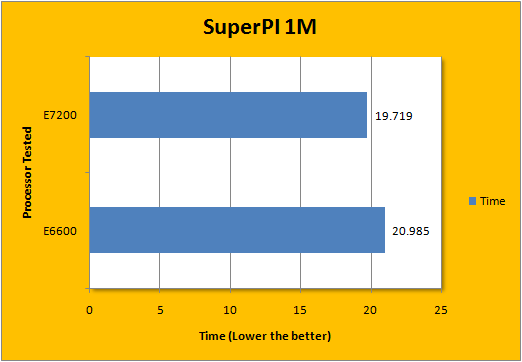
The E7200 beat the E6600 by a little over a second, which translated to an approximate 5% performance advantage. Generally speaking, to conclude the benchmarking section, the 5.4% clock increase of the E7200 over the E6600 yielded a performance gain of generally less than that; but the E7200 is still one heck of a processor for a very reasonable price. It just has less cache which did hinder its performance at some points.
Now, onto overclocking. Everyone's favorite. In this section, we began testing the voltage at 1.25V (There's nothing much to see before that) and increased in increments of 0.05V to see what maximum overclock we can get from each section.
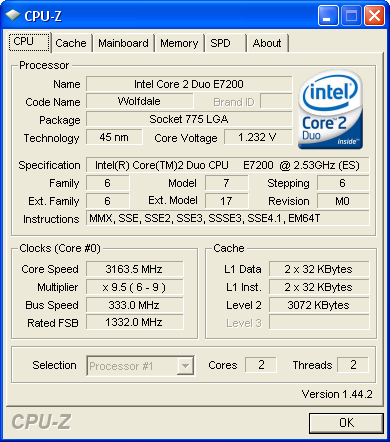
Running a relatively low 1.25V through the E7200, we changed the FSB to to 333MHz (1333MHz QDR) on our Gigabyte X48T-DQ6 and quickly reached a 3.16GHz clock speed from 2.53GHz -- quite impressive in my opinion for such a low voltage. That's a 20% overclock right off the bat.
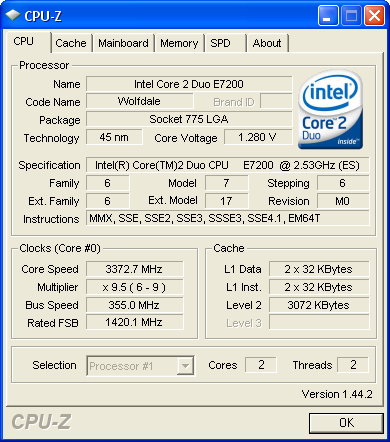
At 1.30V, the maximum FSB we were able to attain was 355MHz, resulting in a clock speed of 3.37GHz -- that's a 25% overclock right there.
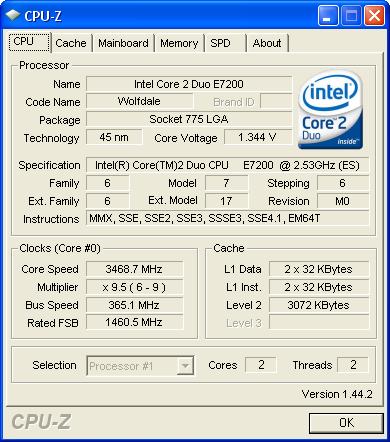
Bumping up another 0.5V to 1.35V allowed us to increase the FSB by another 10MHz to 3.47GHz -- a 27% overclock from stock.
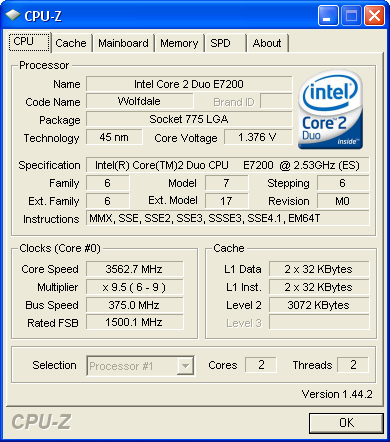
Generally speaking, we won't recommend voltages past this point on your Wolfdale CPU -- but we'll see how the fun continues. At this point, it seems that voltage increase to maximum clock speed increase is uniform; we bumped the front size bux up another 10MHz to get a clock speed of 3.56GHz -- a 29% overclock from original.
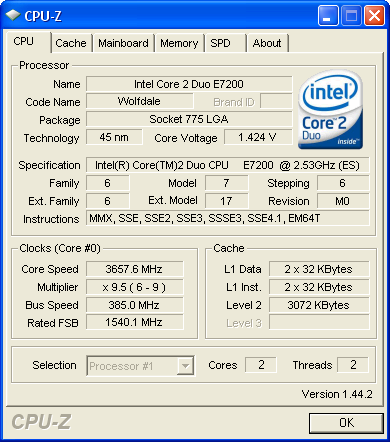
We settled down on a maximum voltage of 1.45V, since running 1.5V through your Core 2 CPU is not recommended as it may significantly shorten the life span of your processor. Again, another 10MHz FSB clock speed increase brought us a maximum overclock of 3.66GHz on the Intel Core 2 Duo E7200 -- a reasonable 31% overclock from the stock speed of 2.53GHz.
Generally speaking, the Intel Core 2 Duo E7200 overclocked fairly decently. Our E7200 is an engineering sample from Intel, where some may challenge that this may be a 'cream of the crop' processor sent out to reviewers, I found that, at least my particular ES CPU, was well within the range of most users in terms of overclocking -- in fact, I've seen some E7200 retail box CPU hit 3.8GHz and beyond, so feel free to tell us of your results.
Page Index
1. Introduction and Specifications
2. Intel E7200 Architecture; Test System
3. Benchmark: EVEREST CPU
4. Benchmark: EVEREST FPU
5. Benchmark: PCMark05
6. Benchmark: 3DMark06
7. Benchmark: Cinebench R10
8. Benchmark: SYSMark 2007
9. Benchmark: SuperPI 1M; Overclocking
10. Power Consumption and Conclusion