Page 2 - NVIDIA 8800GT Architecture
Manufacturer: NVIDIA
Series: GeForce 8
GPU Core, Process: G92, 65nm
Interface: PCI-E 2.0 (Backwards compatible)
Core Clock (Stock): 600 MHz
Shader Clock (Stock): 1500 MHz
Memory Clock (Stock): 900 MHz (1800 DDR)
Memory Bandwidth: 57.6 GB/sec
Shader Operations: 168000 MOperations/sec
Pixel Fill Rate: 9600 MPixels/sec
Texture Fill Rate: 33600 MTexels/sec
Memory Type: GDDR3
Memory Bus Type: 64x4 (256 bit)
DirectX Compliance: 10.0
OpenGL Compliance: 2.1
PS/VS Version: 4.0/4.0
Shader Processors: 112
Pipeline Layout: Scalar MADD+MUL
Texture Units: 56
Raster Operators: 16
Data above courtesy of GPUReview.com.
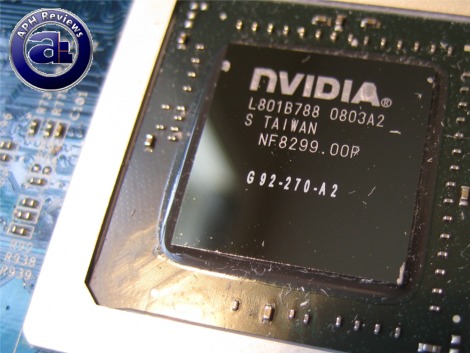
The heart of the new 8800GT is NVIDIA's new G92 core. With a funky naming scheme that would instantly confuse users who are not watching this industry closely, the die shrunk unit is quite a bit faster -- and more power efficient -- than NVIDIA's 90nm G80 used in the previous generation 8800 series cards. Relatively speaking, the G92 based 8800GT is designed to outperform the previous generation 8800GTS G80; in which the G92 based 8800GTS (Typically configured with 512MB RAM) can be stacked up against their 8-series flagship, the 8800GTX. NVIDIA then took the G92 core and deployed them on the 9-series 9800GTX and 9800GX2, then clocked it higher than the 8800GTS G92 to allow them take the spot as the company's flagship cards.
Architecturally speaking, the package NVIDIA puts forth in the 8800GT graphics card is not simply a die shrink that somehow gained tens of percents in performance gain. Being that, G92 is really a derivative of the 90nm G80 core, rather than the 80nm based G84 used on the 8600 series. At 65nm, the new core implements a good chunk of complexity in terms of transistors -- integrating 754 million as juxtaposed to G80's 681 million transistors. The G80 based 8800GTS has 96 active stream processors, whereas the 8800GT has it increased to 112 with 56 texture address units and 56 texture units (1:1 ratio). The stream processors are also clocked high at 1.5GHz that clocks as high as the 8800 Ultra. Keep in mind, however, the 8800GTX based off the G80 core still has 128 stream processors as the 8800GTS G80 has 32 of those disabled.
Thanks to the 65nm process, the die surface shrinks down approximately 33% to 324 mm² from 484 mm² even with much more transistors on board. With that taken into account, there's still a reduction in SPs, texturing power, and not as many ROPs as its higher G80 relatives, but still more shader and texture horsepower than he 8800GTS G80. Anyway, the ROPs are cut down to 16 as the previous generation 8800GTS actually had 20 on board. The NVIDIA 8800GT has a texture fill rate of 33.6 billion/second.
On the other hand, compression algorithm of the ROPs has been improved for insanely high resolutions with the new G92. This may not mean much in terms of 3D graphics acceleration for gaming purposes, simply due to the fact that the 8800GT is not powerful enough to run most games at 30" LCD monitor resolutions anyway. The 8800GTS G92 in SLI may benefit, but other than that -- this architectural enhancement may mean less to the end user.
Additional features added back onto the 8800GT is the native support of dual HDCP dual link DVI output, instead of using a separate display chip. NVIDIA PureVideo 2 hardware video decoding replaces NVIDIA PureVideo on the previous generation G80 cores; which has demonstrated superior hardware decoding performance as compared -- results are seen floating around articles with NVIDIA PureVideo 2 performance on G84 based video cards such as the 8500 and 8600 series. PCIe 2.0 support is implemented as well; despite that this will have no real definition with regards to performance even on PCIe 2.0 boards that offers additional bandwidth, this evolutionary step is also fully backwards compatible.
One step back from the previous generation cards is its 256 bit memory interface with a memory bandwidth of 57.6GB/s as compared to the 8800GTS G80's 320 bit memory interface offering up to 64GB/s.
The Gigabyte GeForce 8800GT TurboForce 512MB clocks the core at 700MHz from stock 600MHz; with memory at 920MHz actual (1840MHz effective clock) as reported from Gigabyte's Gamer HUD software -- which ranks the Gigabyte GeForce 8800GT TurboForce at one of the faster variants of the 8800GT in the market. However, it is 80MHz lower clocked than the Asus 8800GT TOP in terms of actual memory clock, which will make this card slightly behind the 8800GT TOP in benchmarking performance. Interestingly, the Samsung memory chips used on the Gigabyte 8800GT TurboForce actually operates at 1GHz out of the box from Samsung's specifications -- so matching the Asus 8800GT TOP in clocks should not be a big problem.
Page Index
1. Introduction, Specifications, Bundle
2. NVIDIA 8800GT Architecture
3. A Closer Look, Test System
4. Benchmark: FEAR
5. Benchmark: Prey
6. Benchmark: Half Life 2: Lost Coast
7. Benchmark: CS:Source HDR
8. Benchmark: 3DMark06
9. Power Usage, Overclocking
10. Noise Factor and Conclusion