Page 3 - Disassembly and Internals

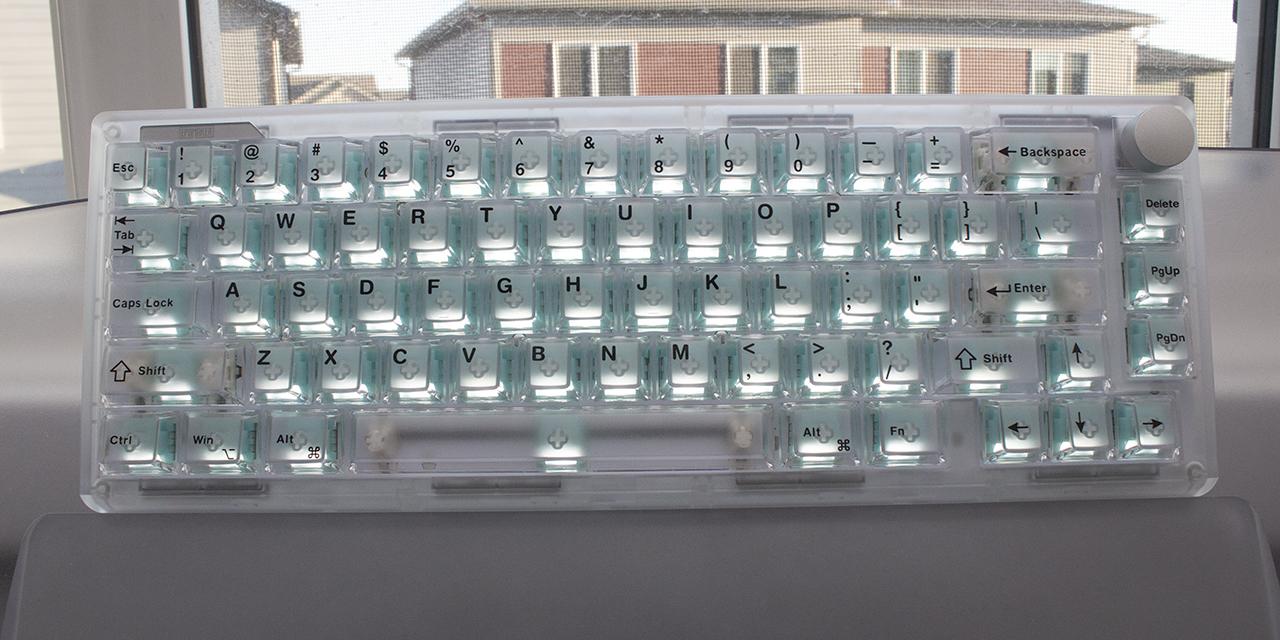
I started the disassembly of the be quiet! Dark Mount Silent Tactile with the main keyboard, leaving the number pad untouched. Removing the keycaps were straightforward, and I immediately noticed how thick they felt. The translucent inner layer under each key is responsible for the RGB LED light diffusion and translucent legends. As mentioned prior, the keys are double-shot PBT, or polybutylene terephthalate, keycaps, which allow the keys to be highly resistant to wear and tear. The PBT keycaps also produce a deeper, muted sound compared to their ABS, or acrylonitrile butadiene styrene, counterparts, due to the thicker walls and higher density. The keycaps support standard Cherry MX stems and have an OEM profile. The larger keys feature plate-mounted stabilizers, which are pre-lubed and surprisingly solid. There was no stabilizer rattling at all during testing.

With the keycaps removed, the switches became more visible. The Dark Mount Silent Tactile uses be quiet! Silent Tactile Black switches, which I personally found to feel most like brown switches. The Silent Tactile Black switches are MX-compatible, hot-swappable, and PCB mounted, making key replacement and maintenance simple. Each switch has a POM, or polyoxyethylene, stem, a PA66, or Nylon 66, housing, and a spring that measures 1.3 cm. As advertised, each switch was pre-lubed. No extra switches are included in the box.
More specific information, such as actuation force and travel distance, are not listed on the manufacturer's website. In addition to the be quiet! Silent Tactile Black switches, there is also the option for the be quiet! Silent Linear Orange switches.

Next, I removed the top plate by unscrewing it and carefully releasing the internal clips, taking care not to break the plastic clips, which are somewhat fragile.

The Dark Mount uses a plate-mounted switch design with the PCB sandwiched underneath, supported by multiple layers to dampen sound, as stated on the manufacturer’s website. Two foam layers cover the PCB. The first sits between the brushed aluminum plate and the PCB, while the second lies between the PCB and a thick silicone layer that fills most of the case. These layers significantly reduce keyboard noise. As stated in the previous page, the keys feel quiet without being completely muted. While typing hard still produces some sound, it is much softer and cannot easily be heard from half a meter away.
Beneath all these layers is a daughterboard PCB that controls the modularity of the number pad. It connects via pin headers on either side of the keyboard. While a JST, or Japan Solderless Terminal, cable or a ribbon connection might have been a safer and more secure alternative, this design choice suggests the Dark Mount does not intend for users to frequently access the internals.
Overall, disassembling the Dark Mount gave me a greater appreciation for its hot-swappable sockets, solid stabilizers, and layered sound-dampening. The internal design may feel slightly dated, but quietness and modular functionality remain the focus, which it succeeds in.
Page Index
1. Introduction, Packaging, Specifications
2. A Closer Look - Hardware and Software
3. A Closer Look - Disassembly and Internals
4. Conclusion