By: Evan Lange (Guest Editor)
February 13, 2026
I have used several different keyboards throughout my life, most of them membrane keyboards passed around my family until they eventually gave up the ghost. I used a HAVIT KB389L mechanical keyboard for a while, but that was an exception to the typical office or workstation keyboards I was accustomed to. It was with this user history that I unboxed the Epomaker RT82. Up to this point, I have never used a 75% keyboard for day-to-day tasks. The RT82 provided a very different typing experience compared to my KB389L, with a much quieter and far more satisfying sound than my clicky Blue switches. The product I am looking at today is equipped with Epomaker Creamy Jade Switches. Epomaker is no stranger to us here at APH Networks. The company positions itself as a mechanical keyboard brand focused on making feature-rich, customizable keyboards available at accessible prices, with a wide array of mechanical keyboards available to a broad market of enthusiasts and everyday users rather than merely niche premium buyers. Their mission declares that they focus on "customizability, affordability, and high standards", so the key question is whether the Epomaker RT82, in practical use, meets these criteria? Read on to find out!

Our RT82 unit arrived from Epomaker's location in Shenzhen, China. Traveling with Yanwen, this mid-sized parcel made its way overseas to our APH Networks location in Calgary, Alberta, Canada. It was packaged in a white packing bag. Alongside the Epomaker RT82, we received three other keyboards, including the TH108 Pro and Split70, which we have already reviewed, as well as the Luma40, which will be reviewed in the coming weeks. A few of the boxes had creases or dents upon arrival that can be seen in the photo above, perhaps indicating a bumpy trip to us here in Canada.

The Epomaker RT82’s box features an appealing lavender and black color scheme with white accents. The front of the box displays the name of the keyboard alongside a simplified illustration of the layout. The sides briefly describe product features and list basic specifications, along with QR codes for the Epomaker store. The back of the box is primarily concerned with certifications and warnings. Overall, the packaging is direct and to the point, with information tucked away for those who care to look.
Here are the technical specifications, as listed on the manufacturer’s website:
Brand: Epomaker
Model: RT82 (Retro White Colorway)
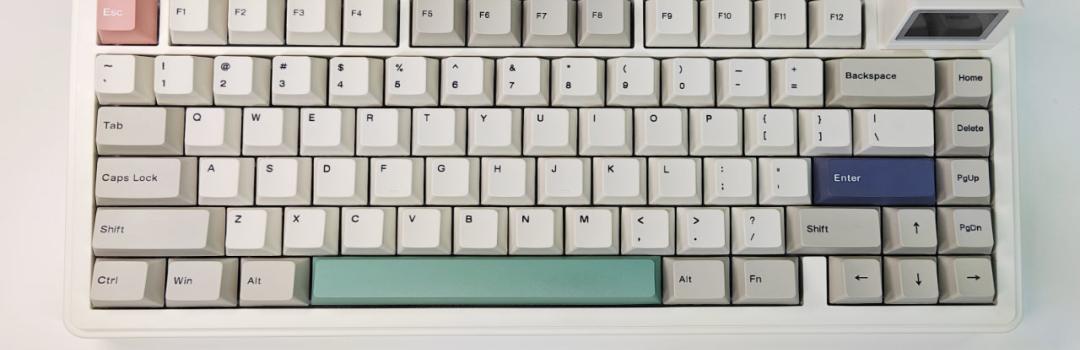
Layout: QWERTY, ANSI US Layout,75%
Number of Keys: 80
Screen: 1.14-inch LCD Screen
Battery: 4000mAh Rechargeable Battery
Battery Life: 14 hours (RGB LED On & Screen On); 17 hours (RGB LED On & Screen Off); 45 hours (RGB LED Off & Screen On); 115 hours (RGB LED Off & Screen Off)
Connectivity: 2.4GHz Wireless/Bluetooth/USB A-C
Compatibility: Mac/WIN/Android
Front Height (mm): 21.8
Typing Angle: 5 degrees, 7.5 degrees, and 11 degrees (two-stage adjustable kickstand)
Case Material: ABS Plastic
Plate Material: PC
Flex-Cut: No Flex Cut
Stabilizers: Plate-Mounted Stabilizers
Mounting Structure: Gasket-Mount
Sound Dampening: Sandwich Latex, IXPE Switch Pad, PET Sound-Enhancement Pad, Bottom foam and Bottom Silicone
Keycaps Profile: Cherry Profile
Keycaps Material: PBT Plastic
Keycaps Manufacturing Technique: Dye-Sublimation Printing
Switch: Pre-Lubed Mechanical Switch
Hot Swappable: Yes, RT82 is Hot-Swappable Keyboard that’s compatible with 3/5-pin mechanical switches
RGB: Yes, RT82 Backlit Keyboard has customizable RGB LED backlight with south-facing per-key LEDs
Polling Rate: 1000Hz in Wired and 2.4GHz Wireless Modes, 125Hz in Bluetooth Mode
Latency: 3ms in Wired Mode, 5ms in 2.4GHz Mode and 15ms in Bluetooth Mode
Anti-Ghosting: Yes, the RT82 Gaming Keyboard supports N-Key Rollover
Keyboard Dimensions (mm): 326.7 x 143.2 x 39.8
Keyboard Weight: Approximately 1kg

Inside the box, you will find the RT82 Keyboard along with a trio of alternate keycaps for Apple MacOS, a keycap and switch puller, multilingual user manual, 2.4GHz receiver, USB Type-A to USB Type-C cable, card with QR codes for VIA and other relevant software and support sites, two extra switches, and a detachable mini display. The keyboard was enclosed in a protective soft plastic sleeve and nested in a cardboard frame, with accessories stored underneath. All accessories were individually packaged or bagged in plastic, except for the cable, card, and manual. The screen was further protected within a foam box. Overall, the quality of the packaging leaves me comfortable with the level of protection provided.
Page Index
1. Introduction, Packaging, Specifications
2. A Closer Look - Hardware and Software
3. A Closer Look - Disassembly and Internals
4. Conclusion