Physical Look - Outside

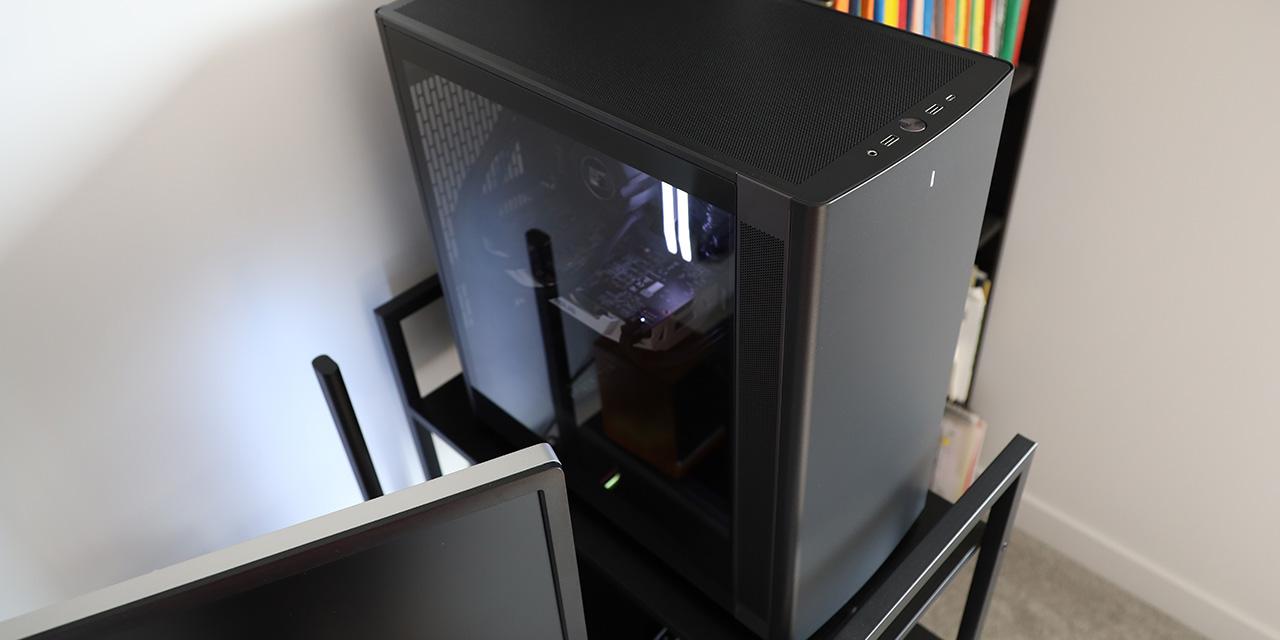
The SAMA S50, like many other cases on the market, employs an aesthetic dominated by mesh and tempered glass, similar to the SAMA V60 reviewed here at APH Networks back in January. However, unlike the V60, which uses a more aquarium design, the S50 opts for a single tempered glass panel on the left side, with mesh and the I/O on the front instead of glass. One feature of interest in this case is the recessed channel that runs the length of the front and top panels, acting to visually separate these panels into two sections. The ridged plastic section of the front panel also adds visible variation. The metal mesh of the front panel is intended to function as a dust filter as well, as no dedicated dust filter is included here. Our specific unit is the white color variant; an alternative black color variant is also available if preferred. The SAMA S50 is slightly shorter than other comparable cases, measuring 426 mm in height, 235 mm in width, and 475 mm in depth. The case weighs at a comfortable 7.3 kg, or about 16.1 lbs. The reason for the reduced height is the intended PSU placement, which is mounted vertically behind the back panel rather than the more typical bottom rear. We will take a closer look at that later.
The left panel of the SAMA S50 is constructed of the tempered glass mentioned earlier, and this window provides very close to full coverage except for a 2cm white bezel around the edges of the panel. The left and right panels are each secured using two ball-and-socket connectors on the top and two metal tabs on the bottom. The right side of the case is made entirely of SPCC steel, with a honeycomb-pattern ventilation pattern cut into it towards the front of the case. A dust filter is included for this section and attaches securely to the inside of the panel using magnetic strips. The rest of the chassis is constructed with SPCC steel and ABS plastic.

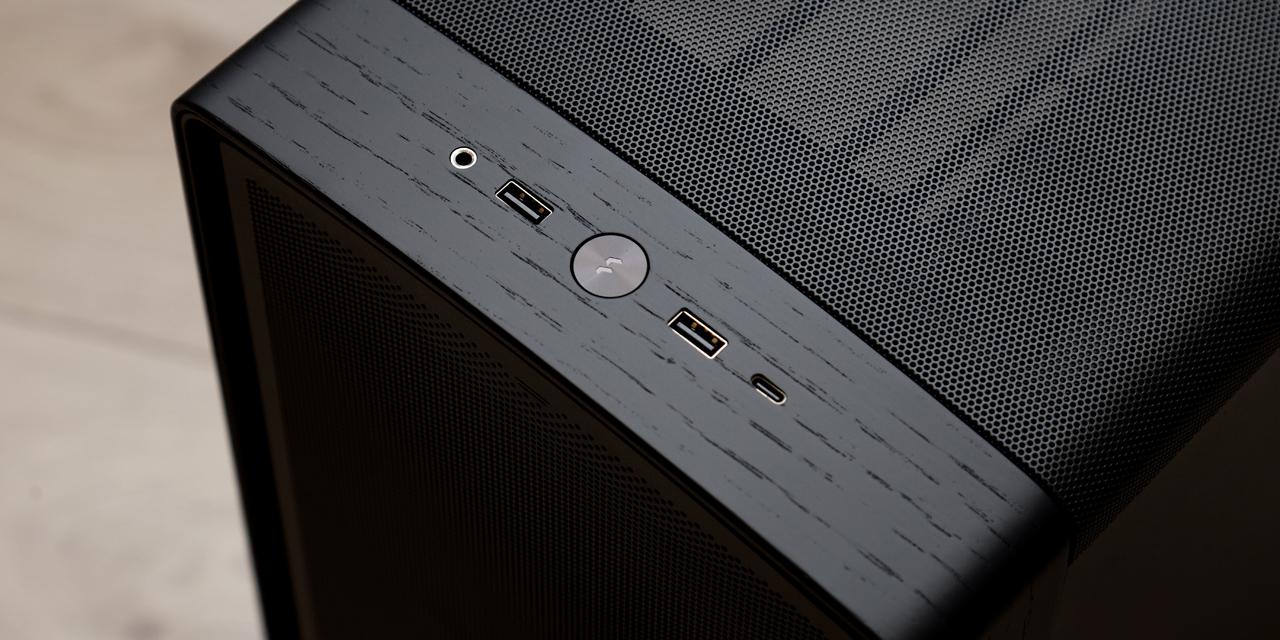
The front panel connectors of the SAMA S50 are lined up vertically on the lower right side. Starting from the top and moving down, we start with the squircle-shaped power button. Following this, we find another squircle-shaped button for controlling the ARGB LEDs. Next in the line is the 3.5mm combination audio jack for headphone out and microphone in, followed by a USB 3.2 Type-C port, and lastly, two USB 3.0 Type-A ports. The RGB LED control button cycles through preset lighting patterns, but if these are not to your liking, the fan lights can instead be controlled by motherboard software instead, activated by holding the RGB LED control for three seconds. There is no reset button or drive activity LED.
Moving now to the top of the SAMA S50, this is almost entirely made from the same mesh we see elsewhere on the case, with a small plastic groove separating the surface into two sections. There is no dedicated dust filter here, which may allow some dust to fall into the case over time. However, this top mesh supposedly doubles as a dust filter and will allow heat to rise directly out of the case, which is especially important as the PSU exhaust grill is located right against this top mesh.
The top panel is fully removable and needs to be removed to install the PSU and access its power switch. The top the case will accommodate up to three 120mm fans, but if you prefer a radiator, you can install one 360mm unit with a maximum thickness of 63mm.

The right side panel of the SAMA S50 is plain except for a honeycomb pattern vent cutout covering about one quarter of the panel. Here we find an included magnetic dust filter. This cutout section is particularly important, as this will be the primary source of fresh air for the PSU with the intake fan immediately behind the filter. An optional 120mm fan can be mounted below this with its own dedicated dust filter as well.
The back of the SAMA S50 is white to match the rest of the chassis, and features more of the honeycomb venting. As mentioned previously, the PSU is not mounted on the bottom of the case, instead located at the back next to the motherboard tray hidden behind a protruding shroud. Next to the included 120mm fan and its mounting point, we find the opening for the motherboard I/O backplate. The power cable plug is located on the top left. Both the tempered glass left panel and solid right panel are connected to the main body of the case through two ball-and-socket connectors on the top edge, and two tabs that fit into grooves on the bottom. The top and front panels can also be removed, and this is achieved by simply pulling them off.
There are seven bridgeless horizontal expansion card slots, painted white to match the rest of the case, as seen above. As they are bridgeless, they are compatible with a vertical GPU riser if you are interested in better displaying your hardware. Next to the slots, there is a hinged door that swings open to give access to the expansion slot screws. This door opens with a simple thumbscrew and is overall a very nice feature.

Moving now to the bottom of the SAMA S50, we find four white plastic feet, with a rubber non-slip pad on each. These feet give the chassis a clearance of about 1.3 cm above the surface it rests on. The feet are detachable with the removal of a single screw, but I do not advise this, as they also contain the bottom grooves that attach to the side panels. The bottom has another honeycomb cutout with another magnetic dust filter that attaches to the exterior. This vented section supports up to three 120mm fans, with a maximum thickness of 28mm. There is no radiator support here.
Overall, the SAMA S50 has good build quality, with a few neat features such as the hinged door on the back. This case fits pretty well into the budget to mid-tier price bracket, so I would not expect an excess of features or small details. The panels fit together well, and nothing feels cheap or fragile. Sharp edges are nowhere to be found.
Page Index
1. Introduction, Packaging, Specifications
2. Physical Look - Outside
3. Physical Look - Inside
4. Installation and Conclusion