Page 3 - A Closer Look - Disassembly and Internals

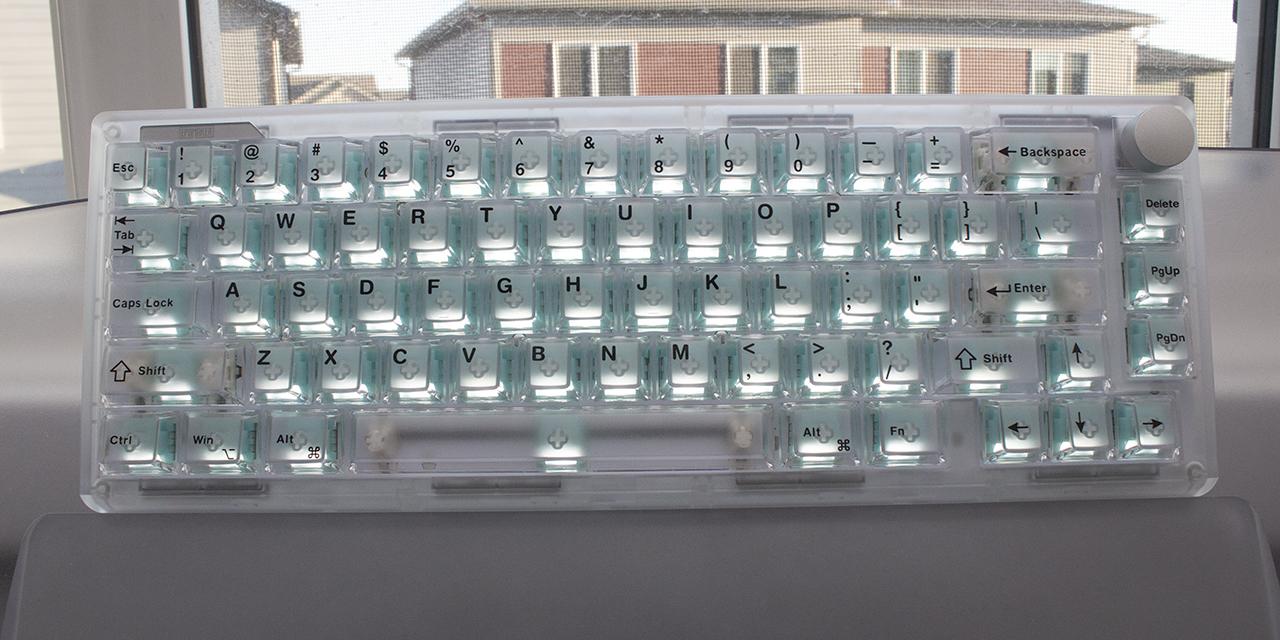
Disassembling the Epomaker RT100 Pro does not require removing the keys, but we will do it to examine them. The keycaps are made with PBT, or polybutylene terephthalate, and dye sublimated. Dye sublimation is a cheaper option compared to double-shot, but it still produces long-lasting legends. Dye sublimation can sometimes cause misalignment issues, which can be found on the Epomaker RT100 Pro we have. The PBT keycaps produce a deeper, muted sound compared to their ABS, or acrylonitrile butadiene styrene, counterparts, due to the thicker walls and higher density. The keycaps support standard Cherry stems and have a Cherry profile. The Cherry-style stabilizers utilized in the larger keys are factory lubricated and plate-mounted. The lubrication is intended to prevent the stabilizer from rattling during typing, which it successfully achieves. All the large keys are attached to the switch at the center and the stabilizer at the outer edges. The keyboard also features full NKRO, or N-key rollover, which allows it to register all keys pressed at the same time.

Our version of the Epomaker RT100 Pro utilizes the Epomaker Sea Salt Silent Switch V2 mechanical switches, which are linear and 5-pin hot-swappable PCB mounted stems. The box-styled stems are made of POM, or polyoxymethylene, while the top housing is made of PC, or polycarbonate, and the bottom housing is made of nylon. All stems are factory lubricated to allow for smooth movement as the keys are pressed. The springs inside the switch measure 18.7mm. The switch actuates at 1.8mm with 45gf of force and bottoms out at 3.5mm with a force of 51gf. In addition to the Epomaker Sea Salt Silent Switch V2 switches, there is also the option for the Epomaker Creamy Jade switches during purchase.

Removing the switches reveals the switch socket pad and the south-facing ARGB LEDs. When I was dismantling the keyboard, I removed all the switches. However, I found out that this was not necessary, as mentioned before. Dismantling the Epomaker RT100 Pro requires first removing the knob, which can be easily pulled out. Then there are clips located throughout the frame that must be released. I stuck a pick into the frame from the underside of the keyboard and moved another pick around to release the others. Afterwards, the top and bottom of the keyboard can be separated to reveal the insides.

At the bottom of the keyboard, there is a silicon pad with a cutout for the 5000mAh battery. Sandwiching the PCB plate, there are the PORON noise-cancelling foam, switch socket pad, and sound enhancement PET. There are also translucent rubber objects around the edges of the frame, which are the gaskets used for mounting the PCB and the plate to the case. Combining all these materials, Epomaker has created the pleasant sound profile mentioned on the previous page.
Page Index
1. Introduction, Packaging, Specifications
2. A Closer Look - Hardware and Software
3. A Closer Look - Disassembly and Internals
4. Conclusion