Page 2 - A Closer Look - Hardware and Software

In terms of appearance, the Epomaker Split70's divided construction will draw some attention. It may look strange on a desk, but there are ways this keyboard can blend in. For one, its split design is still enclosed by thicker black plastic borders on both halves. This ABS plastic frame is finished to hide handling marks, although more greasy fingers may still leave visible evidence. The two boards, even when placed together, have a notable gap between the keys due to the frame. The black shell is complemented by a gradient set of keycaps that transition from a light gray to dark navy blue in five steps. If you are not a fan of this darker color scheme, the Split70 is also available in a lighter white and blue, with more of a cutesy vibe on this brighter option. This is a good first step into adding a bit more color to their boards, but I still want to see more. The rest of the elements of the keyboard, from the frame to the keys, are all squared off with notable corners. The Epomaker logo is not present on the top or front of the keyboard, which also makes it look clean. On an aside, you might be wondering why this keyboard is split in the first place. This allows users to keep their upper body and appendages in an optimal position for a prolonged period, making for a more ergonomic option.
In terms of dimensions, the Epomaker Split70 is 184mm wide on the left side and 188mm wide on the right side. Both sides have a depth of 118mm and a maximum height of 40mm at the back. Together with the cable attaching the two sides together, the Split70 weighs 918g. The keyboard inclines at a seven-degree typing angle. The Split70 feels solid with a minimal amount of flex or torquing on either side. There is still a bit of give, but the keyboard is sturdy and does not move about. The front edge of the frame is approximately 21mm tall, which means you can add a palm rest here, but one is not included. I should also note the two halves are separate, but there are internal magnets on both sides that stick when they are close to each other.

Our Epomaker Split70 keyboard comes in a modified North American QWERTY ANSI layout. This results in a total of seventy-one keys and a volume knob. As the keyboard divides into two, there are many changes here. Starting from the top row, the Escape key is now where the backtick/tilde key would normally be. The backtick is instead on the right side beside Backspace. To accommodate this move, all the numbers on the right side are shifted from one spot to the left. On the fourth row down, we have a pair of "B" keys, with one on each side, so users can press it with either hand. This is typical for split keyboards since "B" is in the middle. The right Shift key is squished into a single 1U key to fit the arrow cluster here. A Delete key is also located to the right of the Up arrow. On the bottom row, the left side has standard 1.25U keys for Left Ctrl, Windows, and Alt. The space bar is half its size. On the right, we have another half space bar, followed by 1.25U Right Alt and Fn. Finally, there is a column of macro keys on the left side, in addition to a volume knob at the top.

Due to the smaller nature of the Epomaker Split70, there are many secondary functions. These are not printed on the keycaps, but you can look at the user manual to find them all. To access these functions, start by pressing the Function key on the bottom right side before the specified key. As there is no dedicated function row, you can press Fn + left Ctrl to toggle the top row between the numbers and F-keys. When the top row represents numbers, pressing Fn before the number will execute that F-key. However, if the top row represents the function row, pressing Fn before F1 to F5 will launch your file browser, internet browser, calculator, mail, and media player. F6 to F9 are used for media keys of Stop, Previous track, Play/Pause, and Next track. F10 to F12 are Mute, Volume Down, and Volume Up, although the volume knob can also execute these functions.
The secondary function of the Windows key will lock or unlock this key, which is handy for gaming. When locked, the backlight under the Windows key will light white. This is the same behavior when Caps Lock is active. Epomaker also supports Mac functions, and they are placed where you might expect on a Mac keyboard. You can toggle between the operating systems with Fn + A for Windows and Fn + S for Mac OS. There are some secondary functions for pairing devices over Bluetooth, as Q, W, and E are used for pairing for three different devices. Fn + R is used to re-pair with the 2.4GHz receiver. To check the current battery life, you can press Fn + B, which will illuminate the top row of keys to show its current percentage. Otherwise, there are keys to substitute the ones removed at this form factor. Y, U, and I are used for Print Screen, Scroll Lock, and Pause. H and J are used for Home and End, while K and L are used for Page Up and Page Down. The secondary function of Delete is Insert, which seems natural. By default, the macro keys on the side are used for common functions of Undo, Cut, Copy and Paste. If you make any changes you want to reset, you can hold down Fn + Backspace, which will revert to factory settings. There are secondary keys for lighting controls, but we will explore these later in the review.

The bottom of the Epomaker Split70 has basically nothing to look at. In the middle of both are differing labels. The left side has just the product name and description, while the right side has certification and other product information. It also notes the keyboard is made in China. The corners have rubber pads to keep the keyboard in place. Unfortunately, there are no kickstands to prop up the keyboard either at the back or to tent the keyboard, which could help with better ergonomics. The only other thing of interest is located on the back edge of both sides. The left side has a holder for a USB dongle, switch to choose between the three operation modes, and a USB Type-C port to connect the keyboard to the computer. There is one more USB Type-C port to connect between the left and right sides. To get the whole keyboard operating, you do need to connect both sides to each other.
The Epomaker Split70 can be used wireless or wired. Inside, there is a 3000mAh battery to keep the keyboard going. In our testing, we found some decent battery life results. Epomaker provides an estimate of up to 11 continuous hours of use with the lights on, and over 260 hours with them off. In our testing, I was able to last around three days without needing to recharge the Split70 with the lights on, which is as expected. I was not using it the full time during the testing duration, and this falls in line with most wireless keyboards too. Unfortunately, I was unable to fully test it without lights on as I did not have enough time, but I think Epomaker's claims are true based on our initial testing. When it functions wired or over the wireless dongle, the Split70 reports at 1000Hz with a latency of 3ms and 5ms. This changes to 125Hz and latency of 15ms when using the keyboard over Bluetooth. To keep this longevity, the keyboard automatically sleeps when it is not in use. Once you press any key, it automatically wakes back up from sleep. This process was quite smooth, and it barely took any time to wake up.

On the table, the Epomaker Split70 fits in the gray XTracGear Carbonic XXL. In terms of layout, the keyboard was difficult to get used to. First, the number row being shifted over on the right side means they are different from my muscle memory. I ended up remapping the top row and put the backtick key in the center. Secondly, the right Shift only 1U sized means I accidentally hit the Up arrow often. The Delete key placement and missing right Ctrl is also a bit less than ideal, but it comes with the territory of the size. The volume knob is nice to have for quick adjustments, as are the four macro keys down the side. I am grateful for the ability to remap keys, but I do not think Epomaker should have changed the number row in the first place.
The typing feel and feedback is a highlight of the Epomaker Split70, at least in my opinion. The Split70 only comes in one flavor of switches, which is the Epomaker Wisteria Linear V2 switches. We will inspect these on the next page. From the recording above, you can hear how each keypress sounds for both the single and stabilized keys. Keystroke travel is smooth without any squeaking or scratching feeling. The sound on each press is deep and does not result in a resonating metallic sound. I would not exactly call these thocky, as they also have a clack-like sound too without sounding too cheap. Overall, it is still satisfying to type on, assuming you like this sort of sound. Those who want a quieter keyboard will look elsewhere. Longer keys like the space bar and Enter key have a slightly different pitch, but they do feel similar. When you bottom out any key, the keyboard does not have much flex, which contributes to the higher-pitched sound. Overall, I do like the typing experience, even with the shifted layout.

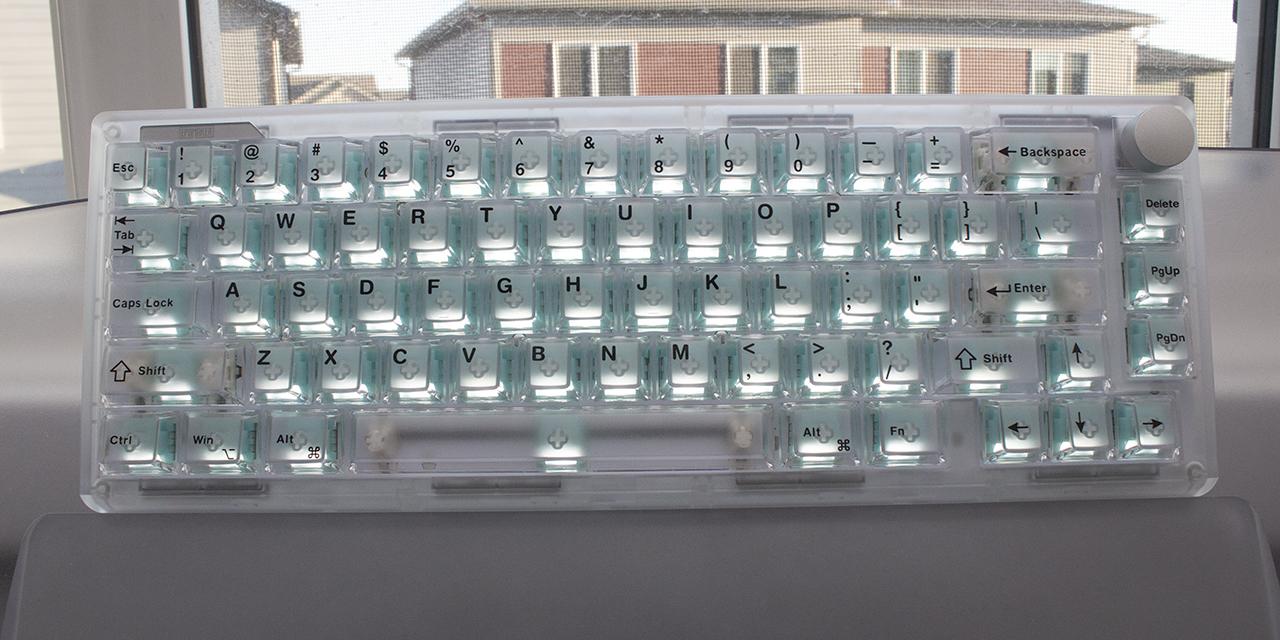
As we have seen from many PBT keycaps, the lighting solution on the Epomaker Split70 is like an underglow, as the light does not shine through. The backplate under the keys is white, which disperses the lighting. Even still, in the dark, you will not see the legends of the keys. The south-facing lights shine around the keycap and are a bit more visible than the alternative north-facing orientation. At maximum brightness, the lights are nice to see and bleed through between the keycaps, even if our photos do not capture it well. Other areas of illumination include a pair of the diffusing bars on the sides of the Split70 for some more color.
Lighting controls can be adjusted via secondary functions. Once again, you need to press Fn first before the specific key. To change the effect, you can press Tab. The square brackets are used to cycle through the hue, while the semi-colon and quotes are used to decrease or increase the saturation. The Up and Down arrows increase and decrease the backlighting brightness, while the Left and Right arrows decrease and increase the speed of the effects. The secondary function of the backslash key is used to cycle through the effects of the side lights. Finally, you can turn off all the backlights with Fn + X.

Epomaker does not make software directly for the Split70, but instead works with VIA. As you have seen from previous reviews, VIA is an open-source keyboard software that has wide support for many different keyboards. While you could download VIA to use on your system, you can also use their web-based application. I tested this on Microsoft Edge, but it should work on other Chromium-based browsers like Google Chrome or Opera. For those who are not familiar with it, VIA has four primary tabs of Configure, Key Tester, Design, and Settings. To get the Split70 recognized with VIA, you will need to upload a JSON file, which can be found on Epomaker's website.
The Configure tab split further into categories. The first category is Keymap, where you can remap keys. This includes both primary and secondary functions. Next is Macros, where you can record macros to be assigned. Save and Load is where you can save the current setup for loading later. Lighting is where you can control the keyboard backlighting in terms of effects, brightness, speeds, and colors. The Key Tester tab is where users can test the key assignments and ensure everything is working as expected. The Design tab is where you can load the JSON file so VIA recognizes the keyboard. Finally, the Settings tab is used for different VIA settings. Overall, it is an extensive application, even if there is a slight learning curve to get started with. I may not be the biggest fan of VIA, but there is no denying its usefulness and cross-compatibility.
Page Index
1. Introduction, Packaging, Specifications
2. A Closer Look - Hardware and Software
3. A Closer Look - Disassembly and Internals
4. Conclusion