Page 2 - Physical Look - Hardware
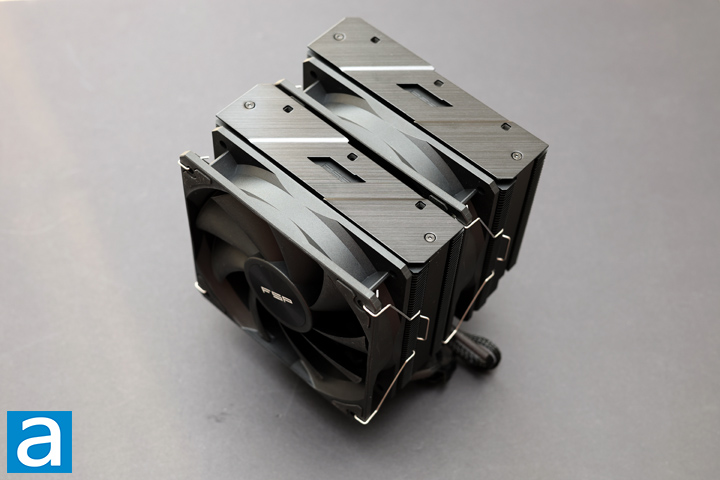
From the anonymous name, the FSP MP7 Black comes in a generic package. Its all-black finish is the only thing to stand out from its design. Otherwise, we have a dual-tower cooler with a 120mm fan attached to each tower. Each side is topped with an additional brushed aluminum plate to make it look more refined and hide the top of the heatpipes. There are three holes on the top, and these are functional, as you will see later. A small cutout is in the middle of the aluminum plate, and underneath is some FSP branding. The only other FSP markings are found on the hub of the fan. Otherwise, there is not too much else to really speak of from this perspective.
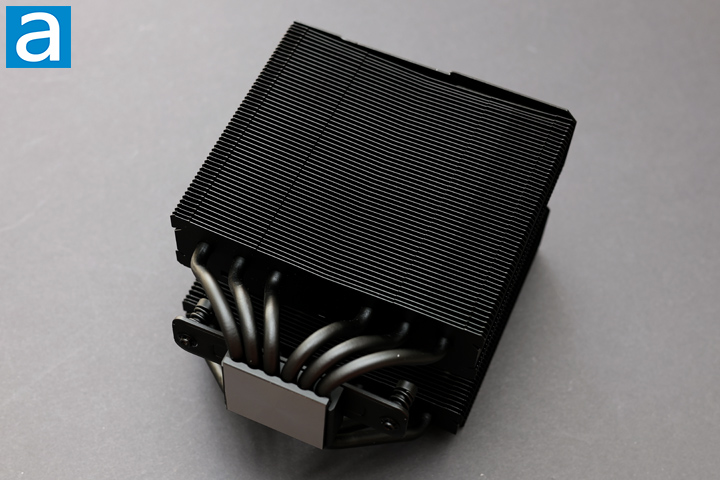
The dimensions of the FSP MP7 Black are 125mm in length, 122.5mm in width, and 153mm in height with the fans attached. These are typical dimensions for a 120mm-based cooler. Based on the placement of the heatsink fins and pipes, the MP7 is an asymmetrical design, with a front leading set of fins sitting more recessed and over the middle compared to the back tower of fins. This is designed to ensure no part of the MP7 Black sits over the memory slots. However, with a fan attached, the closest memory slot may still be blocked. There is approximately 4.2cm of space between the lowest fin and the bottom of the base, but the fans in default positions sit even lower and reduce this clearance by an additional centimeter to 3.2cm. You could raise the fans further if it does not run into height limitations. While there is still interference, the MP7 Black is still good, unless you have high clearance memory in the closest slot.
From the base where the metal contacts the processor, six continuous U-shaped heatpipes lead away from the CPU contact plate and split into the two stacks of fins. This effectively makes twelve heatpipes in total. The 6mm diameter heatpipes lead the heat away from its source due to the low heat of vaporization, or phase change energy, of the fluid inside. They are aligned in a manner to spread out the heat in the array of radiating fins. There is a total of one hundred eleven fins and five more half-sized fins, all separated by a gap of about 2mm. In terms of total surface area, I calculated it to be around 1.0m2 with some rough measurements. In total, this weighs about 990g with the fans attached, or 704g for the heatsink alone. All these aspects should result in the FSP MP7 Black performing well in dissipating heat, but we will see if this is true in our testing.
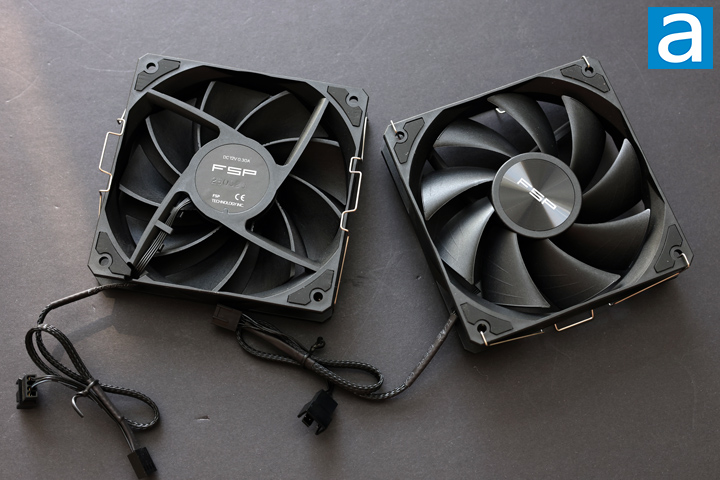
There are two fans here and both are 120mm in size. The fan does not seem to be a retail grade fan, but FSP has provided some specifications, including a maximum airflow and air pressure of 76CFM and 2.1mmH2O. This produces an overall noise level of 32dBA. The fans are PWM-controlled with fluid dynamic bearings and can spin at speeds of 800 to 1800RPM. Each fan attaches to one of the stacks with metal clips on both sides to hook onto the sides of the fins. The metal clips mean the fan placement is flexible and can move about if you run into interference. At the end of the fan cables are a pair of PWM headers, with one male and one female connection so you can daisy-chain multiple fans together and only occupy one header on the motherboard.

At the base of the FSP MP7 Black, we can see how the heatpipes lead out of the base and into the fin array. The base itself is very flat and should translate into an even pressure applied across the top of the processor. A quick inspection also reveals there are no marks on the bottom and only shows the circular milling marks. The base and heatpipes are composed of copper. Copper is used because it has excellent heat transfer characteristics with a thermal conductivity of 401W/mK. The fins are an aluminum alloy, which is quite a bit lighter than copper. This reduction in weight will reduce stress on the motherboard, although aluminum has a lower conductivity of 237W/mK. This might not be optimal for heat transfer, but the trade-off is understandable.
On the outside, the copper base is concealed with an electroplated nickel. While nickel has a lower conductivity at 90.9W/mK, the layer is thin and should not adversely affect the performance to a signification degree. Furthermore, nickel and nickel-based alloys are used for their ability to withstand corrosion, even in higher temperatures. The reason nickel has these properties is because of its ductility and toughness up to its melting point of 1455c, measured at non-standard pressure. Its face-centered cube crystal structure is highly resistant to corrosion, which means we would not have corroded material built up on the surface. As a result, the FSP MP7 will not lose its cooling performance over time compared to a heatsink with a corroded copper surface.
All the heatpipes are soldered to the base, but the fins are pressed to the heatpipes. Pressed fins are typical but can lead to degradation over time as contact between metals may change due to thermal expansion and contraption. This means fins can slide about and affect the gaps between each fin. Even so, everything is well put together on the FSP MP7 Black. One thing to note is that the black color scratches off easily on the mounting bars, but it does not come off on the heatsink fins or pipes. The uniform color finish does make everything look consistent despite the differences in materials.
Page Index
1. Introduction, Packaging, Specifications
2. Physical Look - Hardware
3. Installation and Test Results
4. Conclusion