Page 2 - Physical Look - Outside

If a modern design is a breath of fresh air, then the HYTE X50 could be called a rushing wind, as its uniqueness comes from its color and shape. The X50 comes in a very vibrant and strong purple that matches the Taro Milk name. Just to note, the case also comes in the Air variant, which swaps out the tempered glass side for another perforated panel, and only comes in black or white. Otherwise, the regular X50 has additional color options of Snow White, Pitch Black, Wild Cherry, Matcha, Strawberry Milk, and Astral Orange. You can see HYTE has fully committed to this color in all the elements visible from the outside.
In terms of shape, I have not seen such a rotund case before. The curvature is on the front, sides, and bottom edges, and this extends to the paw feet underneath. HYTE says this increases the "cuteness" of the case, and I would agree. Otherwise, you can see the entire front is a large grille that reminds me of a microphone or speaker cover. One of my friends commented it looked like an oversized Bluetooth speaker, and I can see where they are coming from. This partially acts as a mesh filter, as these holes are fine enough to prevent larger dust or debris from entering. The left side is where you will see a large, curved glass panel, exposing the area where majority of your components will reside. Overall, while some may not be fans of this design, there is no denying the HYTE X50 is a unique one.
From this angle, you can see all the materials found on the HYTE X50 exterior. This includes a 4mm laminated acoustic glass, 1mm thick steel, and ABS plastic for some areas. The entire enclosure feels very sturdy and does not flex. These materials together translate into a case that weighs just over 11.6kg, which is about as expected for the size and materials. It measures 485mm in height, 510mm in length, and 255mm in width, which are all typical numbers for a mid-tower ATX case.

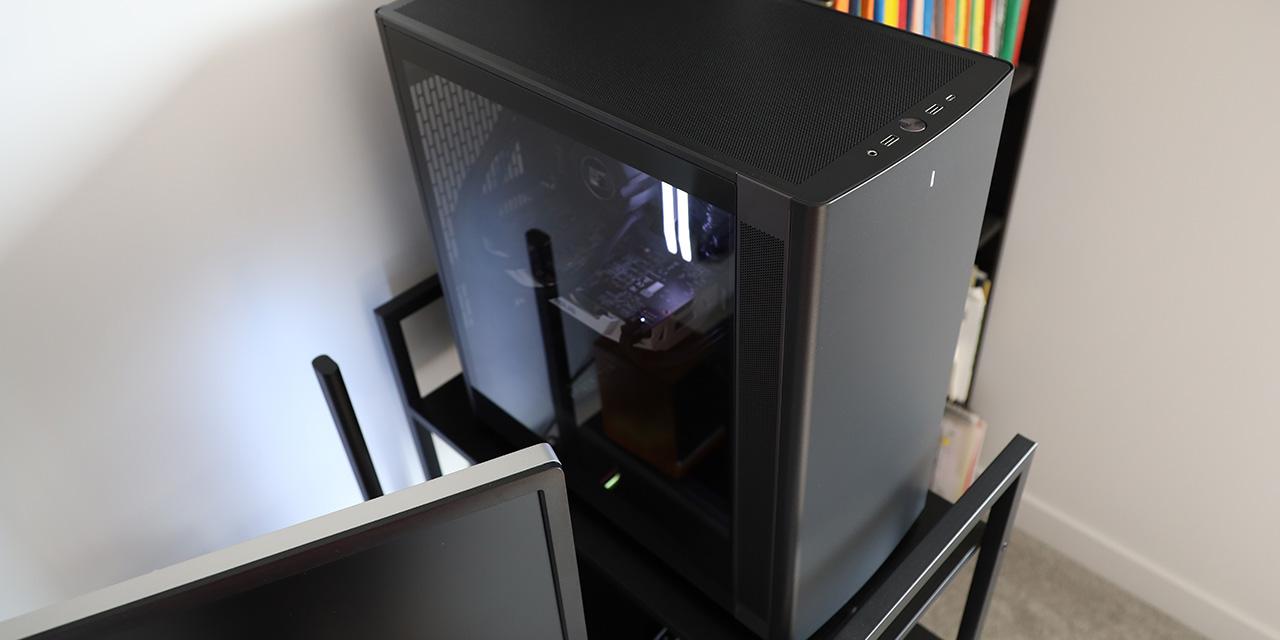
The user-facing I/O are all located on the top of the HYTE X50. The are aligned in a single column between the bending glass and steel side panels. At the very front, there is a circle power button with an LED ring around it, which flashes for power and drive activity. The power button has a nice click, and I am told they used a keyboard switch underneath for maximum pressing satisfaction. Next, there are two USB 3.1 Type-A ports, followed by one USB 3.2 Gen 2 Type-C port. Finally, there is a combined headphone and microphone jack, which is typical for modern cases. Due to the solid nature of the tempered glass panel, you can see there is no exhaust or ventilation directly at the top. Some people prefer this, as it means dust will not settle from the top portion of the case. You can also get a sneak peek of the grille on the right side.

On the other side of the HYTE X50, there is a steel panel full of holes for more ventilation. This is important, as there is a side-facing bracket inside the chassis. On the back side, there is one large HYTE "H" logo, which is the only branding we have on the X50. This is gold in color, and it indicates this is one of the first fifty thousand produced. At the top, there is a large opening for an ATX power supply. It is rare to see a top-mounted power supply in modern cases, but this is what we have. Underneath, there is the opening for the motherboard I/O, followed by a place to mount a single 120mm fan or radiator at the back. Finally, at the bottom are seven expansion slot brackets. These slots and the back are lined with a row of fins that are slightly slanted. It reminds me of Venetian blinds, and is designed to allow for easy airflow. There are also two columns of cable tie down points to help with collecting cables at the back, with additional Velcro straps included for use here.

Underneath, the HYTE X50 has a few areas to note. First, there is a mesh filter at the bottom that is held to the rest of the case with a clip and magnets. This means you can remove the filter for easy cleaning. In the corners, there is a rounded foot that HYTE calls "paw feet" with a pad at the bottom to keep the whole box in place and reduce vibrations between the X50 and the surface it sits on. These feet raise the HYTE X50 off the surface by 23mm, which should allow for air to flow through the bottom. Just to note, the white, black, and red options of the HYTE X50 have two separate bars to raise the case, which is dubbed "contemporary feet".
Page Index
1. Introduction, Packaging, Specifications
2. Physical Look - Outside
3. Physical Look - Inside
4. Installation and Conclusion