Page 3 - A Closer Look - Disassembly and Internals

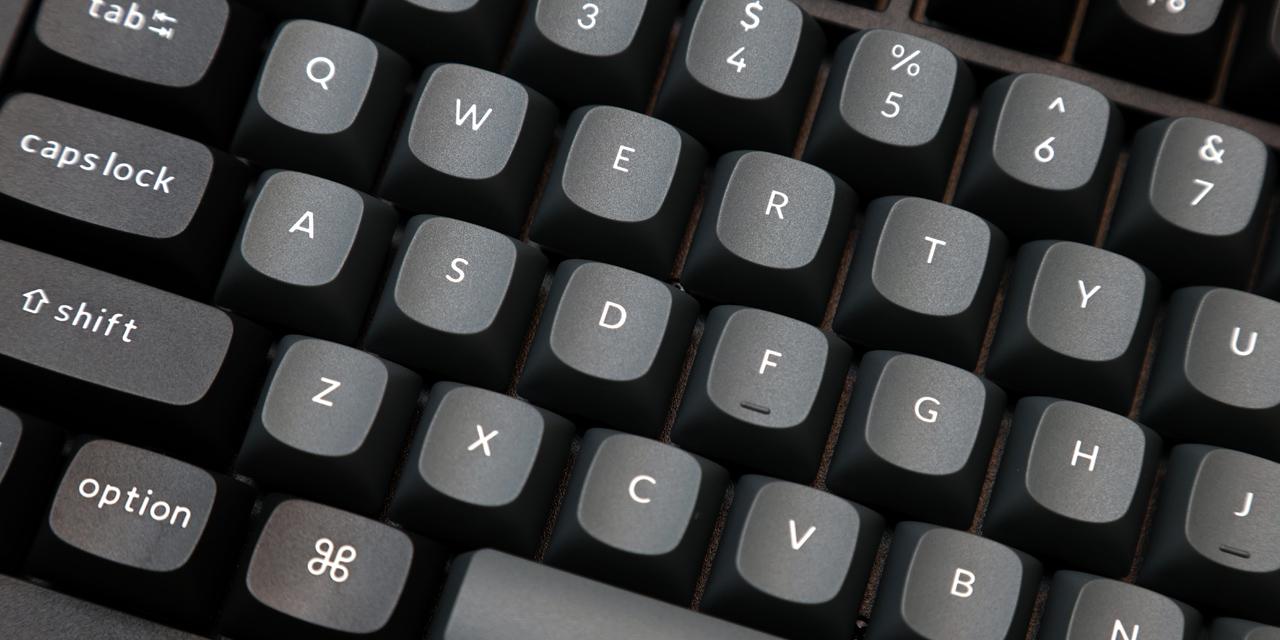
Moving to disassembly, the first step was to remove the keycaps. The keycaps are double-shot polybutylene terephthalate, or PBT. This is a more desirable material than ABS plastic, as it is more durable, better resistant to shine and fading, and has thicker walls for a deeper and more substantial sound while typing. The double-shot injection means the keycaps are made with a second layer of plastic for the legends, so they will not wear out over time. The space bar has two pieces of thick foam stuck inside to act as sound dampeners. The legends on the keycaps are easy to read and have well defined borders. The colors of the legends are black on all keycaps except the caramel colored Escape and Enter keys, where the legend is white for better contrast. The keycaps use standard MX stems. The Keychron K2 HE supports full NKRO, or N-Key rollover, over both wired and wireless connection modes, meaning every individual key is scanned independently and any number of simultaneous keypresses will be registered accurately.

The longer keys of the Keychron K2 HE are outfitted with screw-in stabilizers. This includes the space bar, Backspace, Enter, and left Shift. These stabilizers prevent wobbling and ensure these longer keys produce an even actuation regardless of where you press the key. The K2 HE uses screw-in PCB stabilizers, a step up from the plate-mounted stabilizers found on many other keyboards, screwing directly into the PCB for a more secure and rattle-resistant foundation. They come factory lubricated and provide smooth travel without any rattle, pinging, or squeaking. The plate is made from aluminum and holds up well under pressure with very minimal flex.

One of the central features of the Keychron K2 HE is its switch technology. Hall effect switches share a similar physical structure with their mechanical relatives, with both sharing features such as a housing base, stem, and spring. However, rather than relying on physical contact to register actuation, Hall effect switches instead contain a small magnet inside each switch stem. As the stem travels downwards, the magnet moves, and the resulting change in magnetic field is detected by a Hall effect sensor located on the PCB. This contactless detection method is what enables the K2 HE to use many of its advanced input features, such as its adjustable actuation point and rapid trigger. Hall effect switches tend to last far longer than other switch technologies as there is almost no mechanical wear on the switch.
Keychron advertises the magnetic switches of the K2 HE with a lifespan of 150 million clicks, contrasting with the typical 50 to 100 million actuations from mechanical switches and 5 million from rubber dome membrane switches. The specific sensor technology used is Tunneling Magnetoresistance, or TMR, with magnetic field sensitivity up to 100mV/V/Oe. TMR works by measuring the change in electrical resistance across a magnetic tunnel junction, which is two ferromagnets separated by a thin insulator, between their parallel and antiparallel magnetization states.
The switches of K2 HE under review are Gateron Double-Rail Magnetic Nebula switches. These switches are linear in travel and require a start force of 40g and a bottom-out force of 60g, with a configurable actuation range of 0.2 to 3.8mm, sensitive to 0.1mm. These switches are hot-swappable, but an important thing note here is the K2 HE is only compatible with other double-rail magnetic switches. Standard Hall effect switches from other manufacturers cannot be used.
Taking a closer look at the switch itself, it has a creamy white colored bottom almost identical to the case of the white Special Edition K2 HE. The top is transparent and stamped with Gateron on the south side and a built-in light diffuser on the north side. The stem is a nice purple and is kept raised by a 15mm spring. The stem features a dual-rail design to minimize lateral wobble and comes pre-lubricated from the factory to ensure a smoother feel and sound while typing.

One detail worth acknowledging before continuing is that Keychron has included a screwdriver and hex key alongside the typical combination keycap switch puller, and these tools are all that are needed to take apart the K2 HE. This is a small but meaningful gesture that signals Keychron actively encourages users to open and modify their keyboards. I really appreciate this approach.
After removing all the keycaps and switches, the first step was to remove the two wooden side rails. This was easily done with the included hex key, with two screws per side. Once these were removed, the aluminum rails on the front and back were able to slide off. The next step was to use the included screwdriver and remove thirteen screws holding down the plate. Once the plate was freed, it and the PCB and foam layers attached could be pulled out and turned over, revealing the silicone acoustic pad underneath a thin transparent plastic cover. Beneath these layers sits the 4000mAh battery connected via a small JST, or Japan Solderless Terminal, connector, alongside a daughterboard connected with a larger JST connector and ribbon cable. After disconnecting both, two final screws were removed to lift off the I/O board.

On the board itself, removing the sound-absorbing foam layer revealed the PCB, which contains a message in the center, “Keychron QMK keyboard | more to come", alongside a label detailing the product and PCB version. It is always nice to see intricate details like this during a disassembly. Twenty screws are found on the board. Eight of these screws are a brass color and are responsible for securing the four stabilizers mentioned earlier. The remaining twelve screws secure the plate, PCB, and intermediate sound-absorbing foam together. These are also easily removed, leaving these separable layers and the stabilizers to lift off.

Thirty-nine screws were removed in total, and this was all accomplished using the included tools. Overall, the disassembly process was straightforward. There are only five different screw variants, and they are distinct enough from one another so there will be no confusion over which screw goes where. After reassembly, the keyboard was as fully functional as before, as expected. One thing I appreciate about the overall design is that the finished product is clean and only shows four socket head screws recessed into the wooden side pieces, while not using breakable parts like clips or hidden fasteners.
Page Index
1. Introduction, Packaging, Specifications
2. A Closer Look - Hardware and Software
3. A Closer Look - Disassembly and Internals
4. Conclusion