Page 2 - Physical Look - Hardware
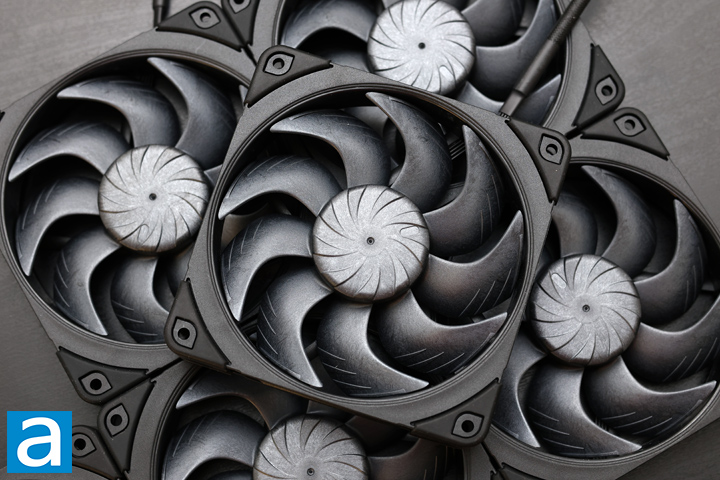
If you think you see double here, I can assure you that you are not, as Noctua has sent us six fans in total. The Noctua NF-A12x25 G2 chromax.black looks like a downsized NF-A14x25 G2 chromax.black series, which is not too surprising given they are from the same family of fans. I have always liked Noctua's chromax.black lineup because it fits in more modern builds, but it does lose the iconic style. Everything from the blades to the frame and cable are black. It should be noted there is a greater engineering feat to changing the color, since the different pigments used for the standard tan-beige and chromax.black affect the blade differently, which can affect the material and performance of the blade. As such, there often is a time gap between the original and chromax.black editions to ensure both versions of the fans perform the same. Otherwise, Noctua branding is limited to a label on the output side of the fan.
Inside, the Noctua NF-A12x25 G2 PWM chromax.black fans use Noctua's SSO2 bearings, which is a further refined version of fluid dynamic bearings. Compared to their original SSO bearings, the second revision has magnets closer to the rotor axis for a higher magnetic force. This should result in improved stability, precision, and durability. This fan has a mean time to failure of 150,000 hours, which translates to over 17 years. In addition, Noctua offers a 6-year warranty.
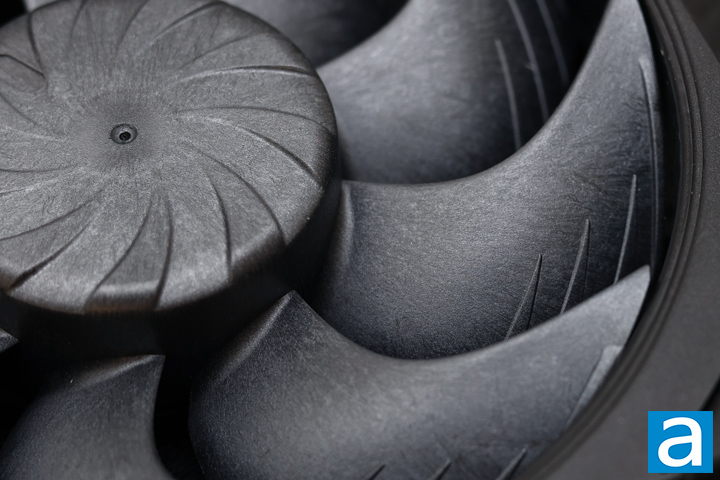
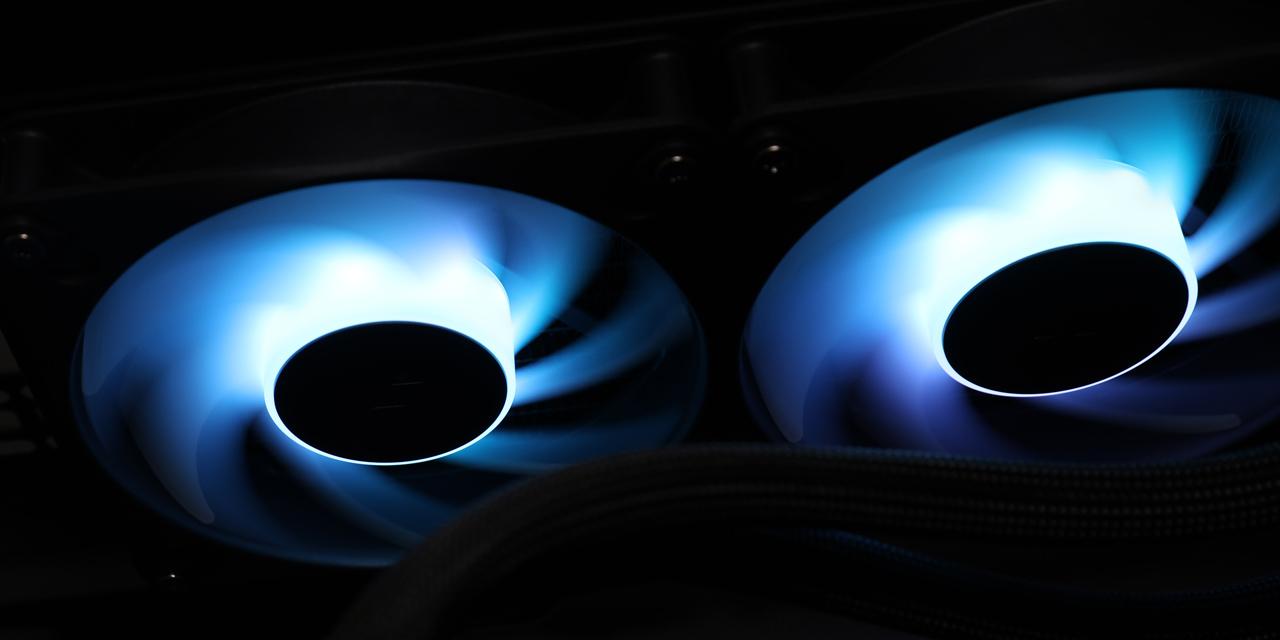
Upon closer inspection of the Noctua NF-A12x25 G2 PWM chromax.black fan blades, there are some notable physical aspects. There is a total of nine blades on the impeller. Each one is curved but with less perceivable spacing between each blade. Still, there are no overlapping areas. The angle it sits in comparison to the rotating middle is around 45 degrees throughout, although the blade also curves. They hook out dramatically in one swoop as you move towards the ends with the tips, flaring out more than in the middle. Each blade has three stripes on the tip, which Noctua calls flow acceleration channels to reduce noise and improve efficiency. Also, there is a notable pattern on the rotor head, which is meant to direct air away from this middle area. The gap between the blade and the frame is also extremely tight.
When it comes to the materials of the fans, Noctua boasts about the use of liquid crystal polymer or LCP for the impeller, while the frame is PBT plastic. In general, LCP is unique from other plastics due to its aligned molecular structure in both its melted and solid phase with a rod-like molecular alignment. This specific liquid crystal polymer by Noctua is dubbed Sterrox, and the result is a material that provides better stability, reduces creep or deformation, greater tensile strength, and a low thermal expansion coefficient. This means Noctua can tighten the tolerance and reduce the gap between the tip of the fan and the frame to 0.5mm, as the impeller will not change over time. The stronger plastic also ensures the blade does not move laterally, as the rotating blades are stronger.
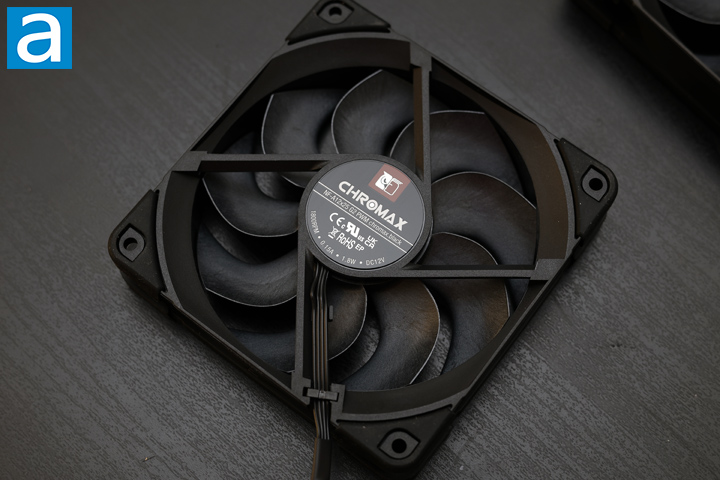
On the other side, four arms hold the middle area and only slightly obstruct air from passing through. This means we should have a near-maximum amount of air flowing through the passage. You should be careful that your fingers do not get in the way of a moving impeller, especially with the lack of any grille here. In the middle, there is a Noctua label that shows the product logo. It also indicates the maximum fan speed, as well as operational voltage of 12V, current of 0.15A, and power draw of 1.8W. A cable leads out the back measuring 20cm in length, but an extension cable is included to increase this to 50cm if necessary. I partly wish Noctua made the standard cable longer so we do not need an extension, but I can see a scenario where you may not want the extra length. The cable is braided and terminates with a standard PWM 4-pin header. Each corner has rubber pads around the mounting holes. These damp vibrations between the fan and to whatever it is attached. A NA-AVG1 chromax.black anti-vibration gasket is also provided to swap with the corner pads when using the fan on a radiator, as it provides a better seal between the fan and the radiator.
On the topics of sound, airflow, and static pressure, the following lessons on these issues have been borrowed from my colleague Jonathan Kwan's review of the Noctua NF-F12 PWM and NF-P12 PWM fans. Noise and CFM relate to the challenge when designing fans, which is to provide the best airflow-to-noise ratio. One would want the best amount of airflow while keeping it as quiet as possible. Even with the best ratio, it is quite difficult to always measure objectively. The most common unit of objective measurement is CFM, or cubic feet per minute, of air for airflow, and dB noise, respectively. We will go over how application and CFM is related with regards to its standard measurements, but let us discuss perceived noise first.
dB, or Decibels, is a logarithmic unit of sound intensity. While it provides an objective measurement, it should be noted that perceived noise levels to the human ear and actual sound intensity could result in quite different things. Human ears are more sensitive to certain frequencies, and when those frequencies are emitted from their source, it may appear louder than the numbers suggest. That same can be said vice versa -- frequencies that human ears are less sensitive can have louder dB measurements from a sound meter, yet the human ears do not perceive it to be as loud as the numbers suggest. Other factors such as turbulence noise are often not measured correctly, therefore, while it usually provides a good reference, it does not necessarily reflect real life performance all the time. As such, a scaled unit of dBA, or Decibels A-weighted, is used to measure sound with it scaled to the human hearing threshold.
With regards to the application and CFM, it is generally optimal to have a fan to have a high air volume flow rate. However, pure CFM values are limited to an extent with regards to its indication on fan performance. It is not completely about how much air in can move per minute quantitatively, but equally as important is how it is executed. Airflow-to-noise ratio is an essential factor as mentioned earlier. Static pressure is also particularly important depending on application. High resistance applications such as dense fins on a large heatsink require high static pressure, while case fans need less static pressure and faster airflow. There are times where case fans will require higher static pressure too, such as the front intake fans where a mesh grille would create some resistance. Some fans are simply designed for different purposes, so choose one appropriate for your needs.
As for its specifications, the Noctua NF-A12x25 G2 chromax.black PWM fan operates at a maximum 1800RPM. Meanwhile, the two PWM Sx2-PP package fans are offset by 50RPM from the standard PWM fan, which claims to reduce harmonic noise when operating in a push-pull configuration or adjacent to each other such as in a case or on an AIO radiator. As such, the two fans operate at maximum speeds of 1750 and 1850RPM. Otherwise, the rest of the operating specifications are the same. When operating at maximum speed, all fans produce 63.15CFM airflow, 22.5dBA noise, and 3.14mmH2O air pressure. Given its size and numbers, these fans can be used for all purposes, whether in a case or over a radiator. We will see how the fan fares in our testing on the next page.
Page Index
1. Introduction, Packaging, Specifications
2. Physical Look - Hardware
3. Performance Tests
4. Conclusion