Page 3 - Installation and Test Results

Noctua's installation process has always been simple, and the NH-D15 G2 chromax.black is no exception. Noctua packaged each set of installation accessories individually for excellent organization. Along with the clear and concise setup poster, setup was a breeze. This is not to mention I have used the SecuFirm2 series system for more than a decade, including the latest SecuFirm2+ system with the Noctua NH-D15 G2 HBC.
As you can see from my photo above, Noctua's mounting system on the Intel platform utilizes a proprietary backplate supplied by Noctua that installs over the stock plate for optimal weight distribution. The inertia generated by such a large heatsink is really something that needs to be addressed accordingly, otherwise it may simply fall out or cause excess stress on the motherboard. To start, insert four bolts into the appropriate hole position and lock them in with the spacers on the other side. In the previous Noctua backplate revision, the bolts were integrated, but the latest change allows wider compatibility with different Intel sockets, and the addition of spacers provides a better fit. Next, align the openings on the supplied backplate with the screws of the motherboard's stock backplate, and flip the motherboard around.

Two mounting bars are included for attaching the heatsink to the motherboard. First, put the plastic spacers on to each bolt. The user then has the choice of either aligning the mounting bars according to the final desired orientation of the cooler, as the NH-D15 G2 chromax.black can be installed either horizontally or vertically. Our photo above shows the alignment of the mounting bars for a standard horizontal installation. In the latest revision, Noctua changed to Torx socket screw caps, which is an interesting but strange choice. A long Torx screwdriver is included, but if you ever lose it, those who do not own a comprehensive toolbox at home are going to have a headache. Tighten the screw caps over the bolts using the provided NM-SD1 Torx screwdriver, and you are good to go.
Fastening the heatsink over the CPU socket proves to be a simple job after I applied some NT-H2 over my CPU. Remove the center fan to gain access to the spring-loaded screw located on the NH-D15 G2 chromax.black heatsink itself. Align the heatsink with the screw threads on the mounting bars, and tighten the screws alternately until they stop. Overall, installation is straightforward, and Noctua's mounting system is very secure and distributes weight very well even though the heatsink is big and heavy. The only hiccup I ran into was the offset fin stack made connecting the fan to my motherboard's fan header more challenging than the standard NH-D15 chromax.black.
The NH-D15 G2 chromax.black in single fan configuration mode will not interfere with your RAM like many modern heatsinks thanks to the high clearance fins. If you choose to keep the second NF-A14x25r G2 chromax.black on, you may start to have issues. As I have mentioned earlier, it will definitely interfere with your memory no matter what profile it is. Therefore, you will need to mount the fan a little higher to accommodate the difference. As such, make sure your chassis is wide enough to accommodate the offset fan.

Our test configurations are as follows:
CPU: Intel Core Ultra 7 265K
Motherboard: ASUS ProArt Z890-Creator WiFi
RAM: Corsair Vengeance RGB DDR5-8400 2x24GB
Graphics: ASUS Dual GeForce GTX 1060 3GB
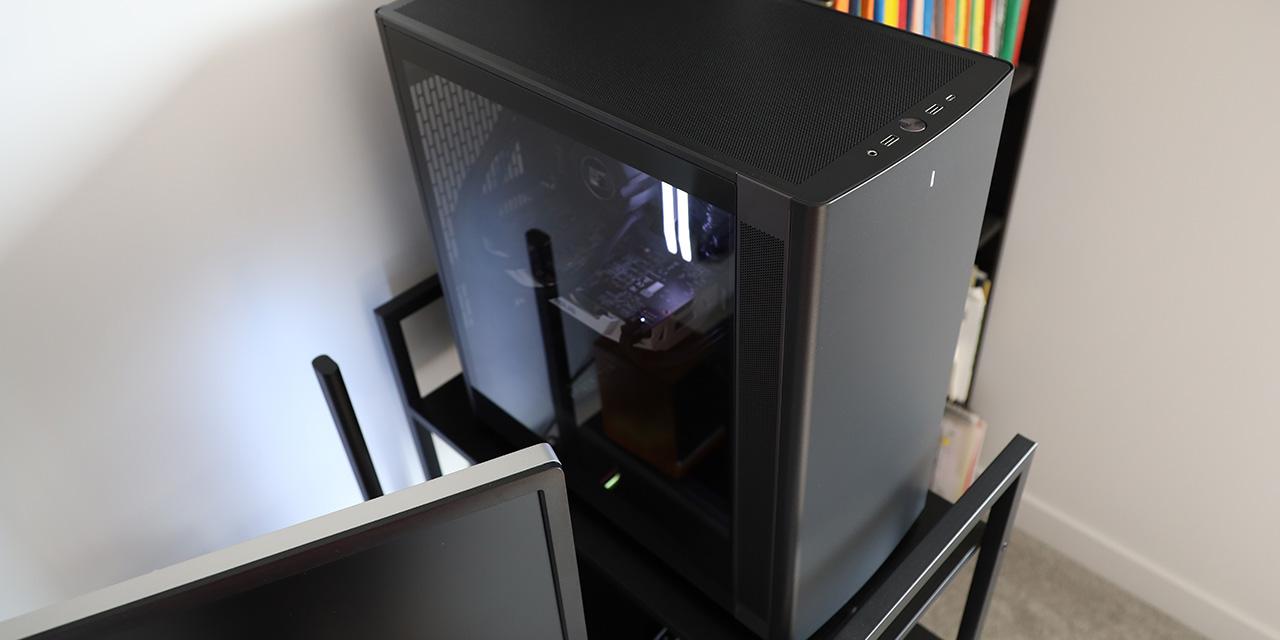
Chassis: Fractal Design Epoch Black TG RGB Light Tint
Storage: Crucial T710 2TB, Crucial T500 2TB
Power: Seasonic PRIME TX-1300 ATX 3.0 1300W
Operating System: Microsoft Windows 11 Pro
Compared hardware:
- Noctua NH-D15 G2 chromax.black (Single Fan)
- Noctua NH-D15 G2 chromax.black (Dual Fan)
- Noctua NH-D15 G2 HBC (Single Fan)
- Noctua NH-D15 G2 HBC (Dual Fan)
All tests were run on our custom-built computer to best reflect real life performance. The computer remained in the same location in the same room throughout all tests. The room temperature in our testing lab was around 21c. Stock thermal paste respective to all coolers were used to rate its performance. All pastes were given a proper amount of time for them to fully settle. The fans on all heatsinks were directly connected to the motherboard's 4-pin connector. The computer was turned on and idled for at least one hour for the idling tests. High CPU load results were obtained using the Prime95 in-place small FFTs test with maximum worker threads for a minimum of ten minutes or until the temperature was deemed stable.


The Noctua NH-D15 G2 chromax.black is an upgraded version of the NH-D15S chromax.black. The NH-D15S chromax.black itself is a modified version of the NH-D15 chromax.black, with an offset fin stack relative to the heatsink base. To summarize the changes discussed on the previous page, the NH-D15 G2 chromax.black has additional fins to increase the total surface area by 0.22m², two additional heatpipes, and new NF-A14x25r G2 PWM Sx2-PP chromax.black fans. We are familiar with the NH-D15 G2 HBC's performance relative to the NH-D15 chromax.black, so I will benchmark the NH-D15 G2 chromax.black against the NH-D15 G2 HBC as a baseline reference. The HBC, or High Base Convexity, variant of the Noctua NH-D15 G2 series is a curved base designed specifically for LGA 1700 and 1851 CPUs' concave integrated heatspreader.
As you can see from our charts above, the Noctua NH-D15 G2 chromax.black performed very well in our idle test. There was, at most, 1c difference between the NH-D15 G2 models and their varying configurations, but there is only so much you can cool on air, as the processor in its idle state is not generating a whole lot of heat to begin with. Since the idle test is not a good indicator of a CPU cooler's true performance potential, let us look ahead into the load test results.
In the load test, the test processor, my Intel Core Ultra 7 265K, generates quite a bit of heat, translating to a very reasonable load to the cooler. The NH-D15 G2 chromax.black in single fan configuration delivered identical numbers to the NH-D15 G2 HBC in the same configuration. The HBC version is technically more optimized for my CPU, but in this case, I was unable to see any difference. Adding a second fan to the NH-D15 G2 chromax.black brought the temperature down 3c. However, it dropped 4c with the HBC version, meaning the Intel-optimized NH-D15 G2 did 1c better than the standard base NH-D15 G2 chromax.black. This is consistent with Noctua's own internal testing, where the difference between the standard and HBC version on an Intel CPU is only about a degree at most. The one-to-two fan performance differential is expected per our past experience with the NH-D15 G2 series. No thermal throttling was noticed on my Core Ultra 7 265K using any of the NH-D15 G2 series coolers.
Generally speaking, from our previous test results, the NH-D15 G2 series is about 3c cooler than the NH-D15 series. The original NH-D15 series is still one of the best air coolers in existence after a decade in the market. To improve the performance of one of the best coolers is an exponentially difficult task limited by the laws of physics. We are hitting a wall with the law of diminishing returns, but if you want the best of the best, the Noctua NH-D15 G2 chromax.black is no doubt that in cooling capabilities.

The airflow test measures the air speed at the outlet of the cooler. The purpose of this test is to see the airflow and static pressure of the installed fan(s), and quantitatively measure how they interact with the design of the heatsink fin array. Higher airflow is better, as it indicates how well the combination of static pressure, airflow, and aerodynamics practically translates to moving heat from metal to the surrounding air.
There was no measured air speed difference between the Noctua NH-D15 G2 chromax.black and NH-D15 G2 HBC. This was unsurprising, as they are basically different colors of the same cooler. Using a single fan, the outlet air speed was 6.4km/h, or 4.0mph. Adding a second fan increased the outlet air speed to 7.5km/h, or 4.7mph.

I measured the noise output of the NF-A14x25r G2 PWM Sx2-PP chromax.black fans running on the NH-D15 G2 chromax.black at maximum speed and compared it against the NH-D15 G2 HBC. As it can be seen in the graph above, there was no noticeable difference in sound intensity between them. This is not surprising, as they are basically identical coolers in different colors.
While this is very subjective, I am quite a picky person on noise. On a scale from 0 to 10 where 0 is silent and 10 is the loudest, I would rate the Noctua NH-D15 G2 chromax.black equipped with a single NF-A14x25r G2 chromax.black to be at 4.5/10 acoustically with its fan running at full speed. Adding a second NF-A14x25r G2 chromax.black bumps this number up to 5.0/10. However, when my computer is idling or under nominal loads -- where it is spending most of the time doing -- the PWM fan slowed down was almost inaudible at 1.0/10. There was no noticeable turbulence noise associated with this cooler, indicating a well-optimized fin array design. Noctua products has probably the best noise profile in the industry, and the NH-D15 G2 chromax.black was no exception. Overall, in terms of sound emissions, the NH-D15 G2 chromax.black is an unquestionably excellent choice for quiet PC enthusiasts.
Page Index
1. Introduction, Packaging, Specifications
2. Physical Look - Hardware
3. Installation and Test Results
4. Conclusion