Page 2 – Physical Look – Outside

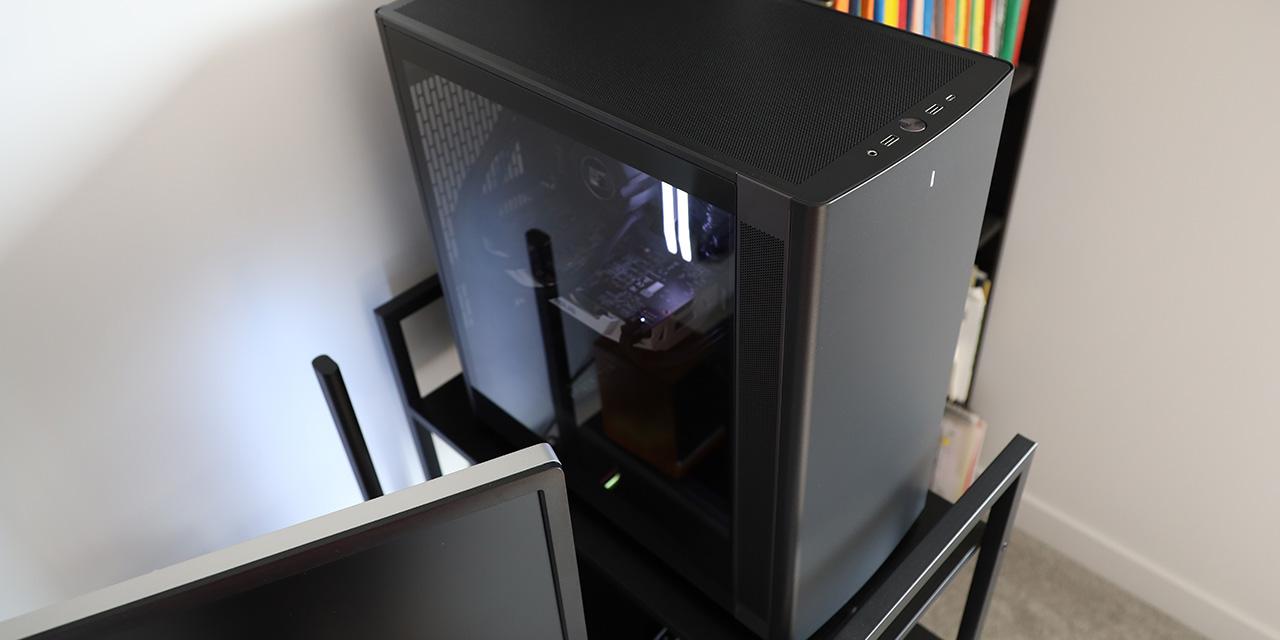
Like many gaming cases on the market, the SAMA V60 I am reviewing today features tempered glass. But instead of the usual single glass side panel, SAMA goes a step further with two tempered glass panels, with one on the left side as expected, and another on the front. With both the left side and front fully transparent, you can show off ARGB LED fans, lighting, and hardware with very little visual obstruction. As you can see in the photos, the side panel is a simple flat sheet of glass, while the front panel have subtle curves along both edges. That curved front glass blends neatly into the side profile, helping the case look more cohesive, and honestly, pretty sleek. The tradeoff is that there is no 5.25" bay up front, so internal optical drives are off the table. This has been the trend for the last few years anyway. For most people, that will not matter, unless you still enjoy watching Blu-ray discs in 2026 and do not want to rely on an external drive.
A glass front panel also means you cannot pull air directly through the front like a traditional mesh-front case. To compensate, the V60 uses a side intake. The steel side section includes two large stamped mesh grilles that feed air to the fans or radiator mounted behind them. The mesh openings provide a strong airflow, while the steel construction keeps the structure rigid and durable. The main downside is that there is no dedicated dust filter behind these mesh intakes. Instead, the mesh supposedly doubles as a dust filter, but it is not the same as a real dust filter. You will likely want to stay on top of cleaning, especially in a dusty room. Up top, the SAMA V60 includes a ventilated mounting area for fans and radiators, along with a removable mesh dust filter to help keep debris out of the system.
In terms of dimensions, the V60 measures 285mm wide, 398mm tall, and 475mm deep. That is noticeably wider and lower than many mid-towers, and it is one of the widest mid-tower layouts I have personally built with. The extra width gives the impression that cable management should be easier, since more side clearance usually means less fighting with bulky cables. It also suggests plenty of room for airflow hardware, with generous fan and radiator support that can turn this into a serious cooling-focused build.

In the photo above, you can clearly see the layout of the ports and buttons provided on the case. The front I/O layout is clean and practical. The large power button sits right at the front edge, making it easy to reach without even looking. Above it is the reset button, followed by two USB 3.0 Type-A ports with headphone and microphone jacks between them. You also get a USB Type-C port for newer devices. Last but not least, there is an LED button for cycling lighting effects. It comes very handy, especially since the V60 includes an internal ARGB LED control board.

One of the biggest advantages of having both a tempered glass side panel and a tempered glass front panel is the clean, unobstructed view into the system. But to really make that work, the two transparent panels need to flow together seamlessly. The moment you add a thick pillar, bracket, or frame between them, you break the illusion, and you introduce visual clutter right where your eyes naturally go. In an ideal world, the side and front would be one continuous piece of glass, but that creates a whole new challenge of designing a locking mechanism that is secure, practical, and still looks clean. This is where the SAMA V60 gets surprisingly clever. As you can see in the photo, there is no obvious metal or plastic bracket separating the front and side glass. Instead, the two panels meet in a way that feels almost seamless, mainly thanks to the small gap and the curvature, keeping the view into the case wide open. Along the edges where the glass interfaces with the non-glass panels, SAMA adds white accent strips. They almost highlight the transition of the glass and drawing attention to how neatly everything comes together rather than looking like an afterthought. Overall, the V60’s front-facing design is genuinely striking, and it is one of the most satisfying glass-to-glass implementations I have seen on a budget case.

The rear of the SAMA V60 is heavily ventilated, with plenty of mesh to help hot air escape. Like most mid-towers, the layout is divided into four familiar zones: The power supply mounting area, motherboard I/O cutout, rear exhaust fan position, and the expansion card slots. Where the V60 differs from a conventional layout is the power supply placement. Instead of being mounted at the bottom in the usual orientation, the PSU is installed along the side of the chassis, and the motherboard sits beside it. It is an unconventional approach similar to the be quiet! Light Base 600 LX and Light Base 900 DX, but it helps explain the case’s distinctive low-and-wide proportions.
Expansion support is standard for an ATX mid-tower. You get seven slots, which should be enough for most gaming builds with dedicated graphics, capture card, and whatever else. One small annoyance, though, is the thumbscrews. They are not the captive type that stay attached to the panel once loosened. If you are used to captive thumbscrews like I am, it is very easy to fumble them. I have to admit more than once I unscrewed a panel and watched a screw tumble straight onto the floor.

There are four plastic stands on the bottom of the case to support the SAMA V60, rising the case up about 1.5 cm on top of the resting surface for ventilation. The pair of front stands are larger than the rear ones. The four stands are on the four corners of the bottom, so there is no doubt about the stability of the case. Meanwhile, there are four rubber bottoms provided to further enhance the grip of the stands. It is nice to have some rubber feet that can offer some kind of protection to your floor or table surface. You can also see from the above photo a washable filter is attached to the bottom grille of the chassis. Here, up to three 120mm fans are supported. In fact, they are actually included from the factory. The filter is removable for easy cleaning and installation. Note the there is no power supply behind the bottom panel, therefore there is no need for extra ventilation area for the power supply.
Overall, the SAMA V60 is a sleek and well-designed computer case constructed from a mix of metal, plastic, and tempered glass. The panel gaps are small and consistent, reflecting a high level of build quality and attention to detail. This is extremely important for a case with both front and side glass panels. The tempered glass itself also stands out for its clarity, showing no noticeable distortion. On the usability front, the inclusion of two USB Type-A ports and one USB Type-C port keeps the case modern and practical for everyday use. Finally, with its good amount of mesh grille coverage, the SAMA V60 is clearly optimized for airflow, ensuring both style and cooling performance go hand in hand.
Page Index
1. Introduction, Packaging, Specifications
2. Physical Look - Outside
3. Physical Look - Inside
4. Installation and Conclusion