Page 3 - Installation and Test Results

Noctua's installation process has always been simple, and the NL-LC1-24 is no exception. Noctua packaged each set of installation accessories individually for excellent organization. Along with the clear and concise setup poster, setup was a breeze. This is not to mention I have used the SecuFirm2 series system for more than a decade, including the latest SecuFirm2+ system.
The radiator configuration and set up process will probably not require a manual for most builders. The NF-A12x25 G2 PWM Sx2-PP cooling fans are attached by four Torx screws each. A 4-pin PWM Y-split cable is included, so you can power both fans off a single motherboard header. Mounting the radiator to your chassis requires more screws just like any other all-in-one water cooler. The only difference is the exclusive use of Torx screws, which is common to all new Noctua products. I find this an interesting but strange choice. While Torx is more durable, I never had an issue with the Philips head design. A long NM-SD1 Torx screwdriver is included, but if you ever lose it, those who do not own a comprehensive toolbox at home are going to have a headache.

Noctua's mounting system on the Intel platform utilizes a proprietary backplate supplied by Noctua that installs over the stock plate for optimal weight distribution. To start, align the integrated bolts on the supplied backplate with the screws of the motherboard's stock backplate, and flip the motherboard around.
Two mounting bars are included for attaching the water block to the motherboard. First, put the plastic spacers on to each integrated bolt. The user then has the choice of either aligning the mounting bars in the standard or offset positions. The offset position is for optimizing the performance on LGA1851 CPUs. Our photo above shows the alignment of the mounting bars for an offset installation on my Intel Core Ultra 7 265K.
Fastening the water block over the CPU socket proves to be a simple job after I applied some Noctua NT-H2 thermal paste over my CPU. Simply align the water block over the two screw threads on the mounting bars. Two Torx socket screw caps are included to secure the water block on. Once that is done, connect the rest of the cables, and your system will be ready to go.
The metal Noctua logo faceplate in the above photo is installed magnetically. All in all, the installation process for the Noctua NL-LC1-24 was very straightforward.

If you have the optional NL-ACF1 auxiliary fan, simply remove the metal Noctua logo faceplate and replace it with the fan. The fan is also held on by magnets. As aforementioned, the NL-ACF1 is used to bring additional airflow over nearby components such as VRMs, RAM, and SSDs. It has no impact on the cooling performance of the CPU itself.

Our test configurations are as follows:
CPU: Intel Core Ultra 7 265K
Motherboard: ASUS ProArt Z890-Creator WiFi
RAM: Corsair Vengeance RGB DDR5-8400 2x24GB
Graphics: ASUS Dual GeForce GTX 1060 3GB
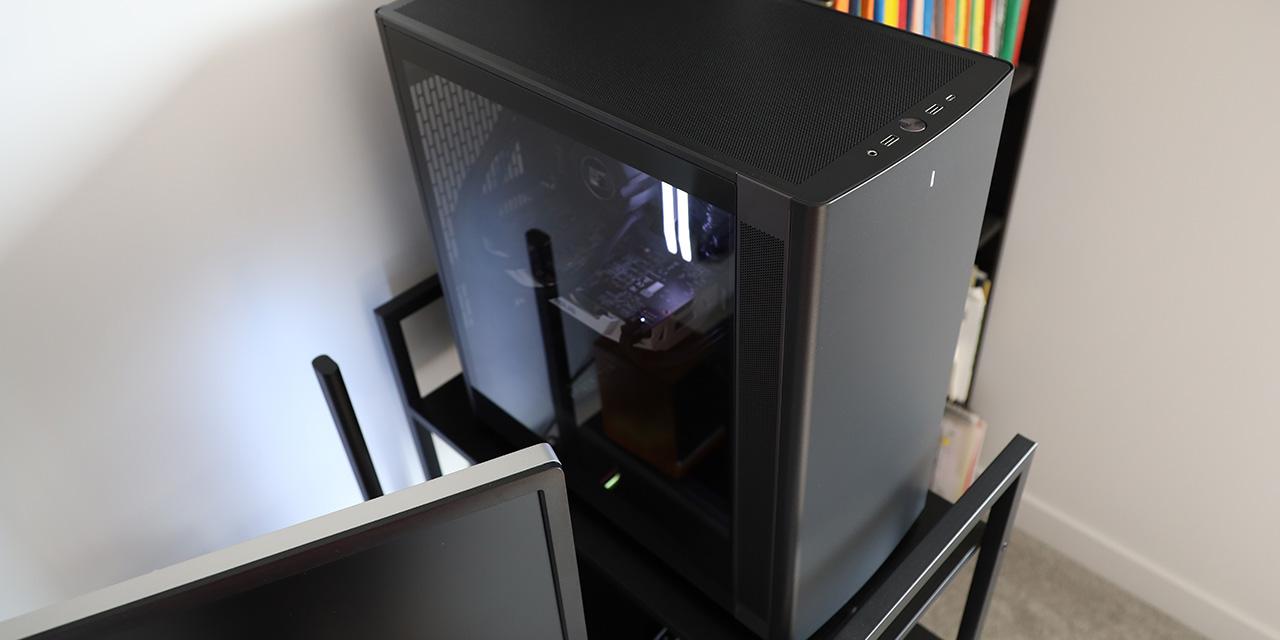
Chassis: Fractal Design Epoch Black TG RGB Light Tint
Storage: Crucial T710 2TB, Crucial T500 2TB
Power: Seasonic PRIME TX-1300 ATX 3.0 1300W
Operating System: Microsoft Windows 11 Pro
Compared hardware:
- Noctua NL-LC1-24
- Noctua NH-D15 G2 chromax.black (Single Fan)
- Noctua NH-D15 G2 chromax.black (Dual Fan)
- Noctua NH-D15 G2 HBC (Single Fan)
- Noctua NH-D15 G2 HBC (Dual Fan)
All tests were run on our custom-built computer to best reflect real life performance. The computer remained in the same location in the same room throughout all tests. The room temperature in our testing lab was around 21c. Stock thermal paste respective to all coolers were used to rate its performance. All pastes were given a proper amount of time for them to fully settle. The fans on all heatsinks were directly connected to the motherboard's 4-pin connector. The computer was turned on and idled for at least one hour for the idling tests. High CPU load results were obtained using the Prime95 in-place small FFTs test with maximum worker threads for a minimum of ten minutes or until the temperature was deemed stable.


As you can see from our charts above, the Noctua NL-LC1-24 performed very well in our idle test. The NH-D15 G2 series are probably the best air coolers available on the market today, so testing the NL-LC1-24 against the best air coolers on the market gives us a good reference as to where Noctua's first AIO stands. There was, at most, 1c difference between the NL-LC1-24 and NH-D15 G2 models in their varying configurations, but there is only so much you can do here, as the processor in its idle state is not generating a whole lot of heat to begin with. Since the idle test is not a good indicator of a CPU cooler's true performance potential, let us look ahead into the load test results.
In the load test, the test processor, my Intel Core Ultra 7 265K, generates quite a bit of heat, translating to a very reasonable load to the cooler. The NL-LC1-24 was a whopping 7c lower than the NH-D15 G2 chromax.black and 6c lower than the NH-D15 G2 HBC in their fully loaded dual fan configuration. Restrict both NH-D15 G2 coolers to only one fan, and the NL-LC1-24 beats them both by a massive 10c. As aforementioned, the NH-D15 G2 series are probably the best air coolers ever made, and routinely perform better than some AIOs. This shows how good the NL-LC1-24 is. No thermal throttling was noticed on my Core Ultra 7 265K using the NL-LC1-24.

The airflow test measures the air speed at the outlet of the cooler. The purpose of this test is to see the airflow and static pressure of the installed fans, and quantitatively measure how they interact with the design of the radiator. Higher airflow is better, as it indicates how well the combination of static pressure, airflow, and aerodynamics practically translates to moving heat from metal to the surrounding air.
The outlet air speed was 11.5km/h, or 7.1mph. The NL-LC1-24 has a 3cm thick radiator, and the 120mm NF-A12x25 G2 PWM Sx2-PP spinning at around 1800 RPM was effective in moving air quickly through it.

I measured the noise output of the NF-A12x25 G2 PWM Sx2-PP fans and NL-LC1-24 pump running at maximum speed and compared it against the NH-D15 G2 series. As it can be seen in the graph above, the NL-LC1-24 was considerably quieter than the NH-D15 G2 series in any configuration.
While this is very subjective, I am quite a picky person on noise. On a scale from 0 to 10 where 0 is silent and 10 is the loudest, I would rate the Noctua NL-LC1-24 with two fans and pump running at full speed to be at 3.5/10 acoustically. The NL-ACF1 auxiliary fan is mostly negligible when deployed, adding at most 0.5 to that number when operating at full speed. However, when my computer is idling or under nominal loads -- where it is spending most of the time doing -- the slowed down PWM fans and pump was almost inaudible at 1.0/10. The pump was basically completely smooth and silent with no perceivable vibration noise, and so were the fans. Noctua products have some of the best noise profiles in the industry that goes beyond what measured sound intensity communicate, and the NL-LC1-24 is yet another testament to the company's engineering excellence. Overall, in terms of sound emissions, the Noctua NL-LC1-24 is an unquestionably excellent choice for quiet PC enthusiasts.
Page Index
1. Introduction, Packaging, Specifications
2. Physical Look - Hardware
3. Installation and Test Results
4. Conclusion