Page 2 - Physical Look - Hardware; Installation

Although APH Networks, as a whole, has covered countless AIO liquid coolers in the past, I have personally reviewed only exactly two prior to the Noctua NL-LC1-24. The AIO coolers I have tested include the Thermaltake WATER2.0 Pro in 2012 and Cooler Master MasterLiquid ML240 Illusion in 2021. My colleagues have reviewed models from practically every other brand that can be found in our Cooling section. It is crazy how things worked out and how time flies.
Compared to pretty much every all-in-one liquid cooler we have ever covered here at APH Networks, the Noctua NL-LC1-24 features your quintessential 240mm radiator based off the Asetek Emma V2 platform. I would not say this is a bad thing, since the distinguishing design elements nowadays are in the water block and included fans, which is exactly what Noctua did. The radiator has a steel frame, black in color, and rectangular in shape with hard corners, measuring in at 279.5mm long, 120mm wide, and 30mm thick. It is completely symmetrical, and you will find Asetek x Noctua's branding subtly printed on both sides. The radiator is made out of aluminum. Aluminum has a thermal conductivity of 237 W/mK, which is not as optimal for heat transfer compared to copper at 401 W/mK as it retains more thermal energy. However, it is much lighter; for applications such as a radiator, this is a fair tradeoff in my opinion.
Our above photo shows the Noctua NL-LC1-24's water block with the NL-PNA1 pump noise absorber installed. From the outside, it has an understated matte black finish, but it comes with a cavity for you to magnetically attach the metal Noctua logo faceplate to give it a nice, finished look. The pump noise absorber features a three-layer soundproofing design, featuring a dense sound barrier sandwiched between two layers of acoustic foam. The floating silicone mount dampens the water block vibrations. All these combined either absorbs, reflects, dampens, or shifts the sound emissions to lower both actual and perceived noise output.

The radiator fins themselves are organized in the classic wave pattern for maximum heat dissipation. At the top, two braided ethylene propylene diene monomer, or EPDM, hoses connect to the CPU water block for coolant exchange. The EPDM hoses have an outer diameter of 12.5mm and inner diameter of 7mm. The tubes are quite flexible and easy to work with, thanks to their 26mm bend radius. The coolant used is composed of 22% propylene glycol and 78% water. The hinged connection at the CPU water block gives a bit of pivoting flexibility for motherboards and cases with different installation positions. The length of the tubes is 400mm long, which should be long enough for most users.

Here is a closer look at the Noctua NL-LC1-24's CPU water block. The pump has a centrifugal impeller with ceramic sleeve and shaft bearings rated at 2W typical power supplied from your motherboard's 12V 4-pin PWM header. The water block measures 70mm thick, and features a smooth and flat contact base. The water block with Noctua's SecuFirm2+ mounting system should exert good contact with your processor. The included high-performance NT-H2 thermal paste is to be separately applied.
The pump can operate in three different modes selectable by the user using a slider switch located on the pump assembly between the hose attachments. These modes include manual mode, balanced mode, and quiet mode, which has a maximum speed of 3400RPM, 2600RPM, and 2100RPM, respectively. The rated noise at those speeds is 14.9dB(A), 7.8dB(A), and <5dB(A), respectively. The switch is tiny, and will require you to look at the manual to know which position represents which configuration.
The cold block is made out of copper with skived fin micro channels. Copper is a good choice as the material, as good heat transfer capabilities are extremely crucial. Copper has a thermal conductivity of 401 W/mK. Since we do not need to worry too much about weight here due to limited size of the pump, it is definitely the right material choice in my opinion. The only thing I would like to see is a nickel-plated contact base on the block. Nickel and nickel-base alloys generally have desirable properties that can withstand corrosive environments and high temperatures, which are especially beneficial for a heat dissipation device. With all this in mind, I found the Noctua NL-LC1-24's overall build quality to be excellent, as one would expect from both Asetek and Noctua.

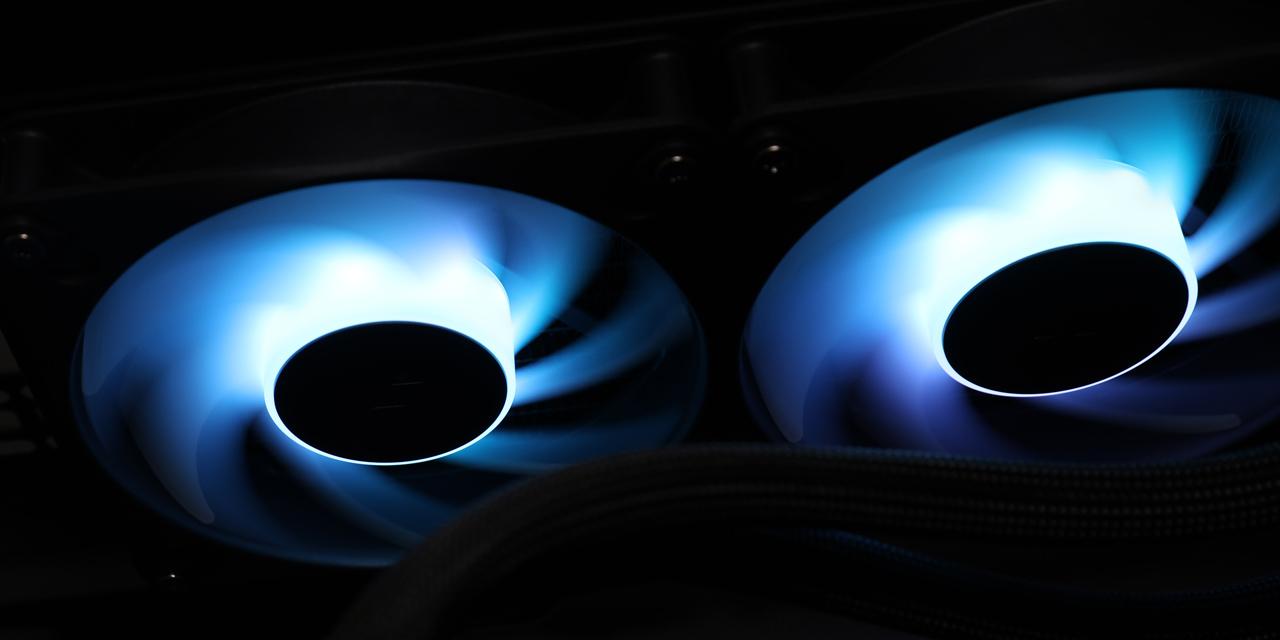
A pair of Noctua NF-A12x25 G2 PWM Sx2-PP 4-pin PWM fans come with the NL-LC1-24, which my colleague Qian Chen has taken a close look at in December of last year. These are Noctua SSO2 bearing fans with a rated MTTF of 150,000 hours, featuring nine blades on each impeller held on to the frame by four arms. These fans are rated at 0 to 1750 or 1850 RPM, 63.15 CFM airflow, 3.14 mmH2O static pressure, and up to 22.5dB(A) of noise. The slight difference in maximum speed is to reduce harmonic noise when operating side-by-side.
The optional Noctua NL-ACF1 auxiliary fan can be magnetically attached to the pump to bring additional airflow over nearby components such as VRMs, RAM, and SSDs. It is a 4-pin PWM fan rated at 0 to 2200 RPM, 32.67 CFM airflow, 2.37 mmH2O static pressure, and up to 17.7dB(A) of noise.
Page Index
1. Introduction, Packaging, Specifications
2. Physical Look - Hardware
3. Installation and Test Results
4. Conclusion